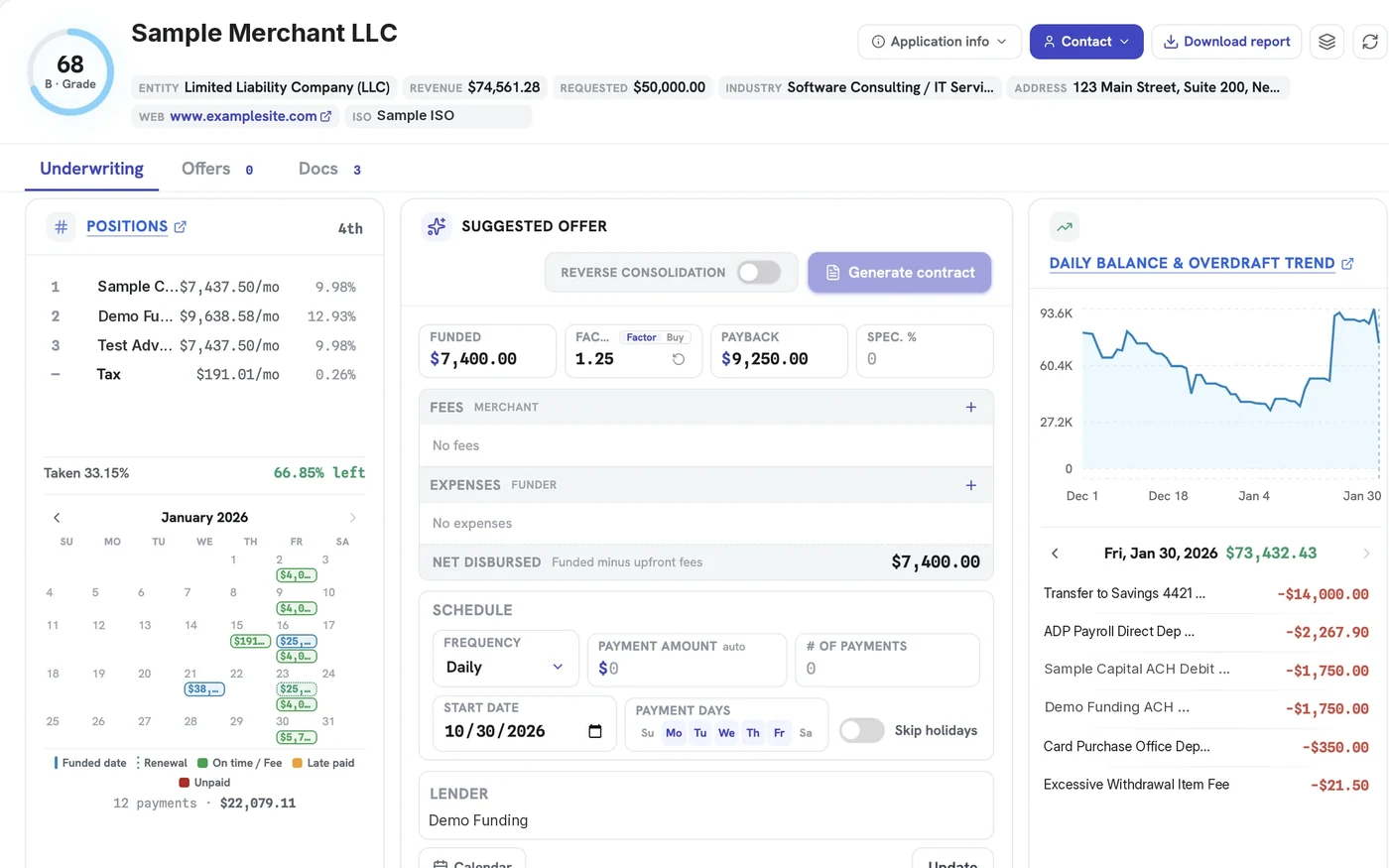
Statement parsing
Bank statements read automatically, no retyping.
Funders, software and service providers across the MCA industry.
Tell us about your shop and we’ll reply within one business day.
We run the books and taxes behind your funding operation, from the first deal to year-end filings.
Clean numbers you can hand to your investors, your syndicators and your CPA.
On a free call, we look at your books, bank accounts and CRM, then confirm how many hours a week your book needs.
We get access to your CRM, bank, ACH system and QuickBooks, and learn how your shop runs.
Daily entries and payments, a monthly close with reports, and year-end taxes, on a set schedule.
| 40+ hours On site option free of charge | $60 |
| 30–39 hours | $63 |
| 25–29 hours | $65 |
| 20–24 hours | $70 |
| 15–19 hours | $75 |
| 11–14 hours | $80 |
| 6–10 hours | $85 |
| 0–5 hours | $90 |
| Review / manager hours | $120 |
| Sales tax, bookkeeping client | $175 |
| Sales tax, non-bookkeeping client | $325 |
| Business year-end taxes | from $1,950 |
| Business year-end taxes, 1 partner | from $2,350 |
| Each additional partner | from $275 |
| Personal year-end taxes | from $350 |
| Full-year write-up (previous year) | from $1,900 |
| Partner / manager consulting, hourly | from $350 / $275 |
| State and federal notices / audit, hourly | $115 |
| Corporation formation | from $600 |
| Cash analysis | $2,000 ($1,000–$4,000) |
“From” prices are starting prices. The final price depends on the size and complexity of the work.
When you work with BAS, real people who know MCA keep your books, not a black box. Here’s the team.




Book a free consultation and we’ll confirm your weekly hours and your rate.
Our team handles the books behind your funding operation, from the first payment on a deal to the last syndicator payout.
We bill bookkeeping by the hour. The more weekly hours your book needs, the lower your rate.
Your rate is set by the total bookkeeping hours you use each week.
Bookkeeping is billed hourly, from $60 to $90 an hour. Tax and business services are priced per service.
Book a free consultation and we’ll confirm your weekly hours and your rate.
AI reads every bank statement, scores the deal against your box, and tracks it to payoff.
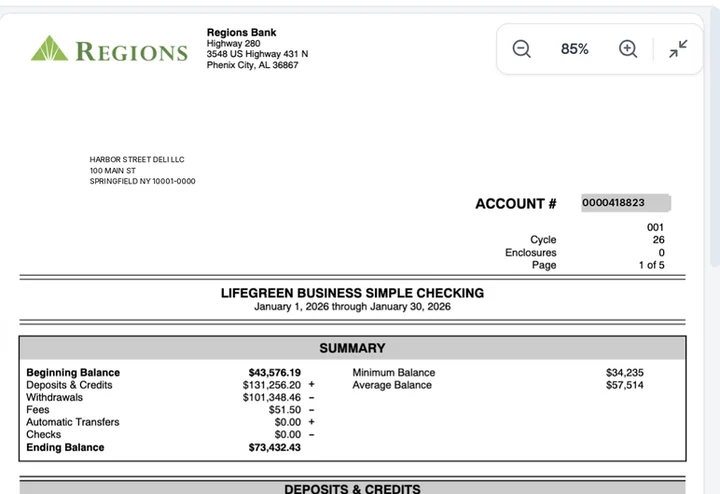
Bank statements are parsed automatically. Each file is then scored, graded and matched with an offer using the criteria you set in your account.
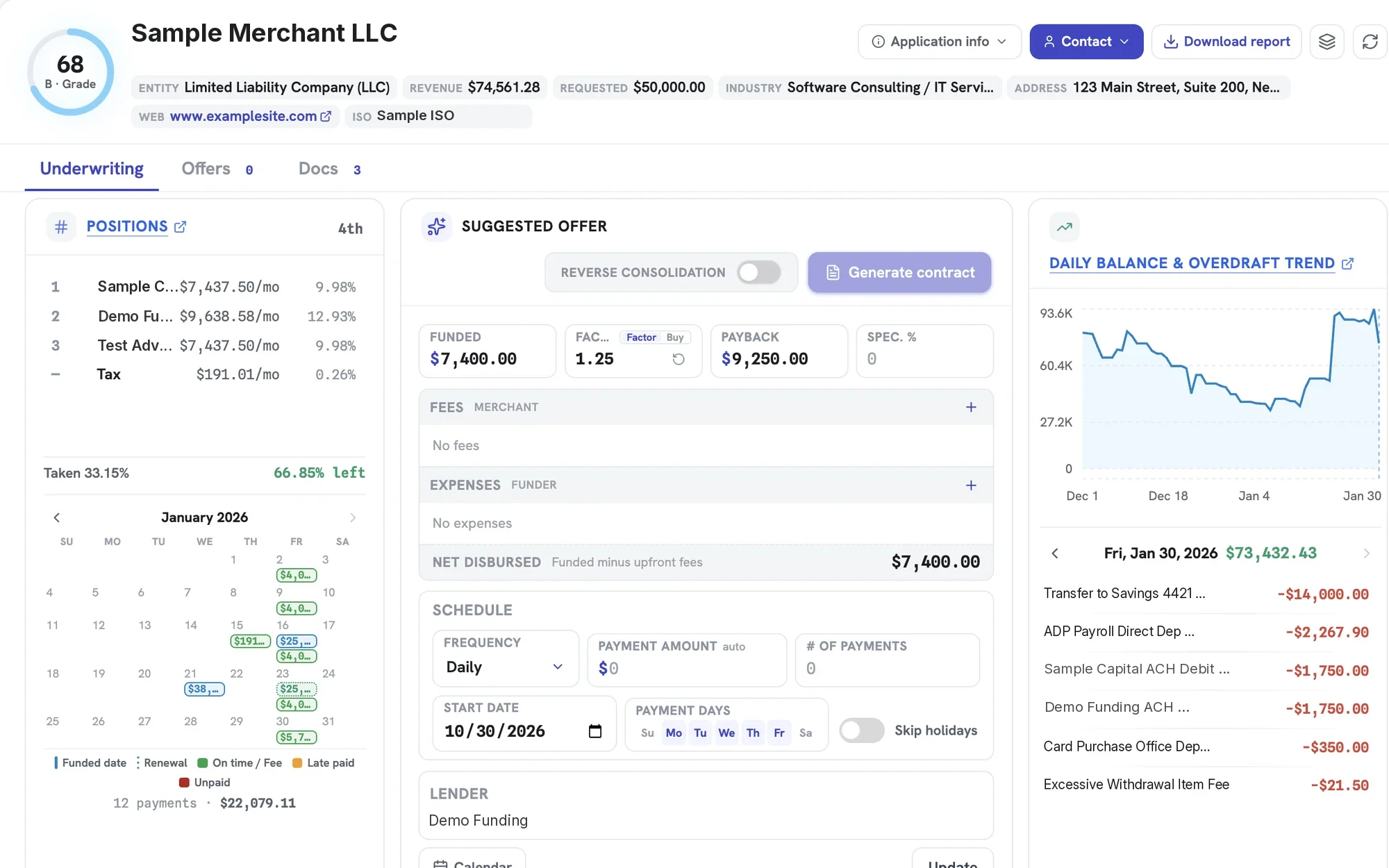
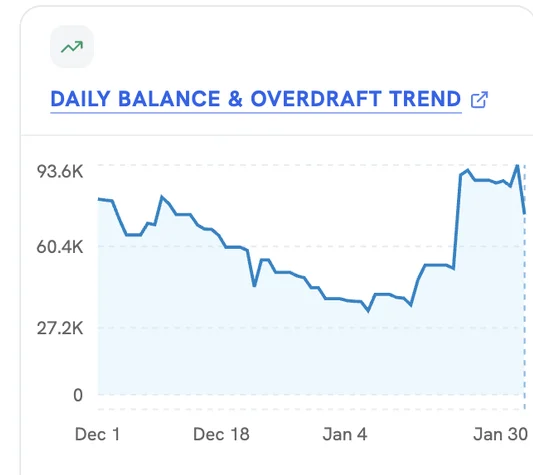
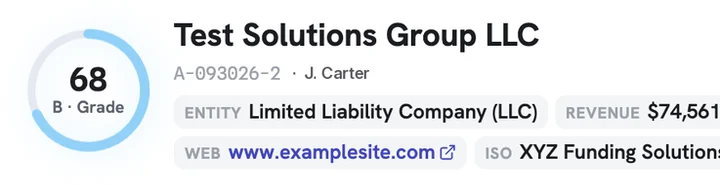
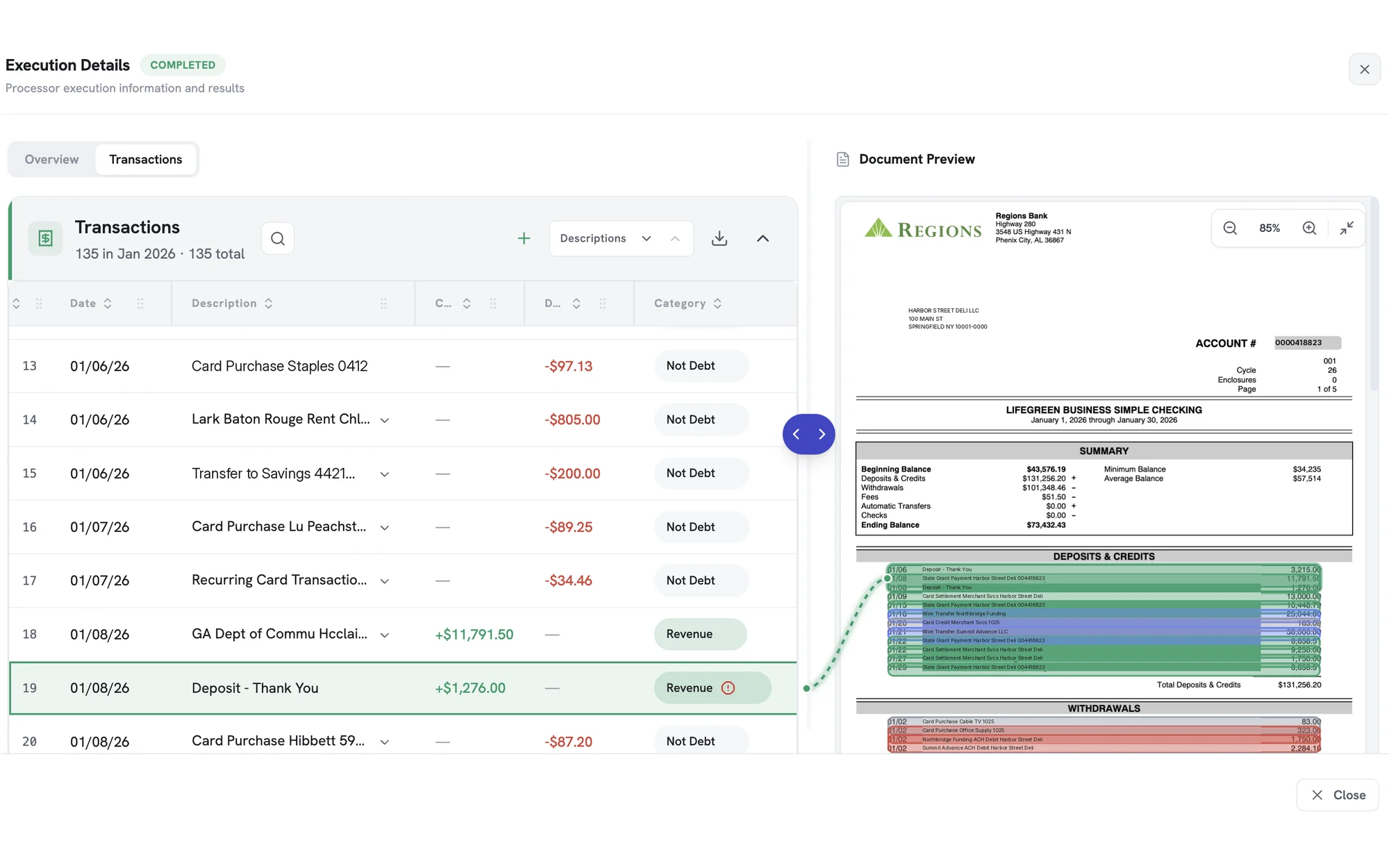
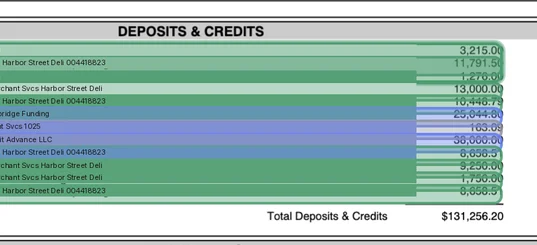
Every parsed transaction is traced back to its line on the bank statement, so you can check the numbers yourself.
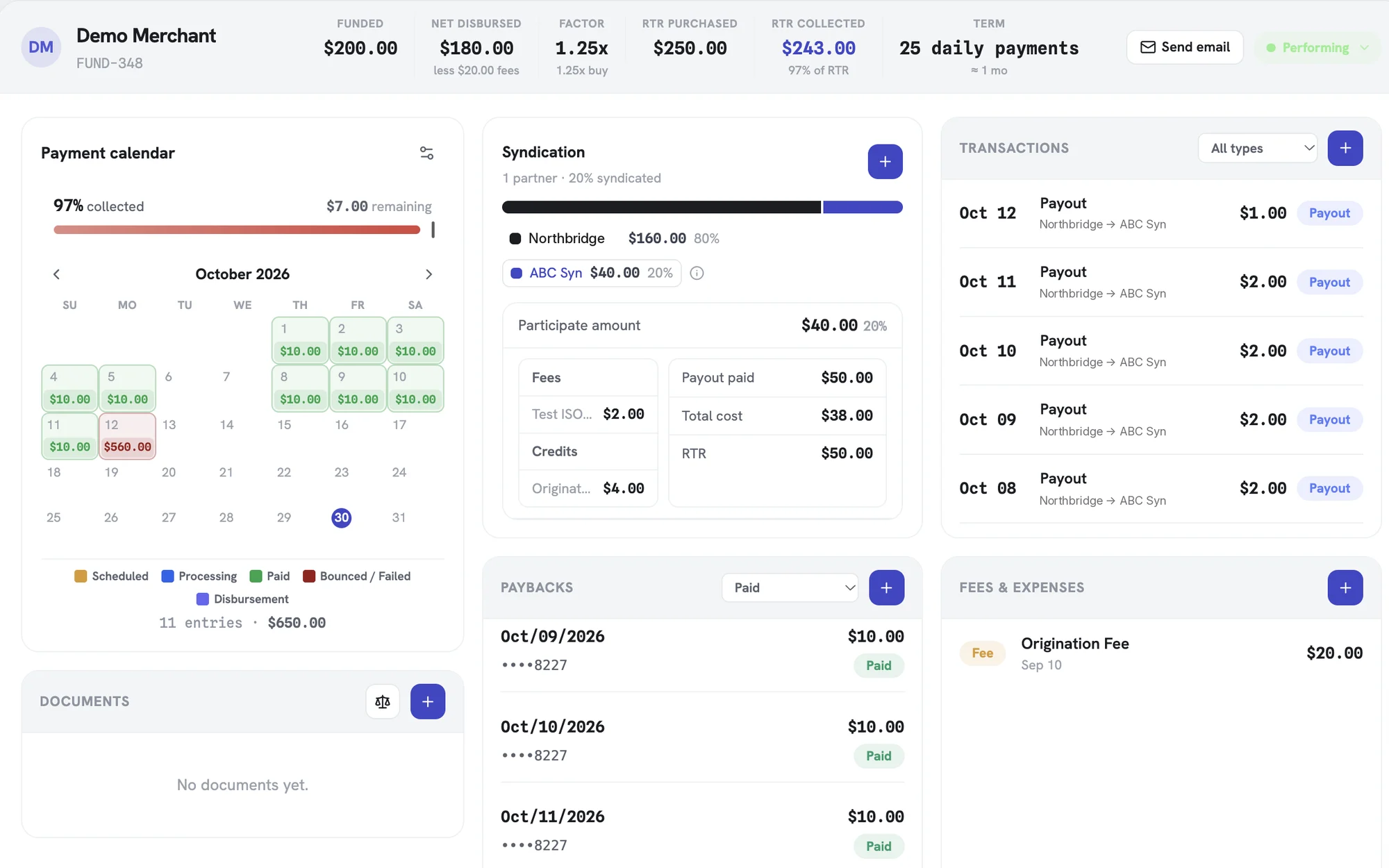
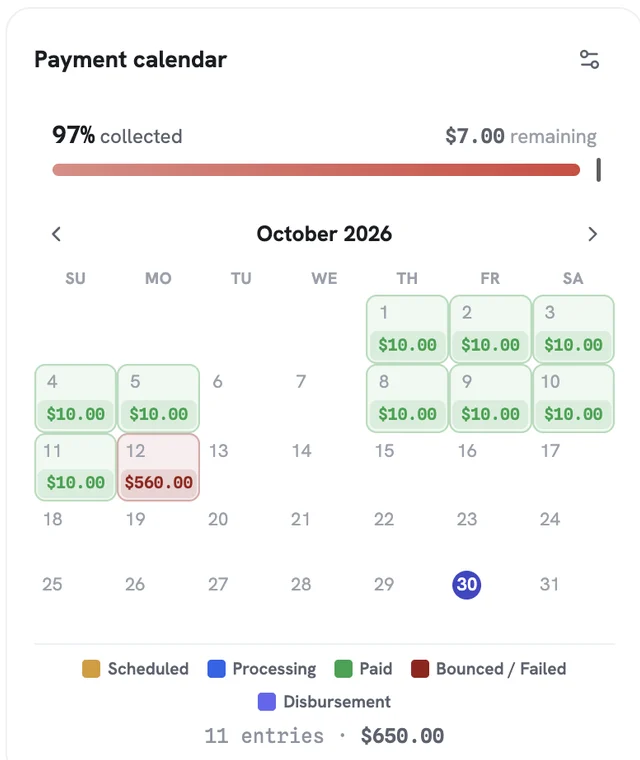
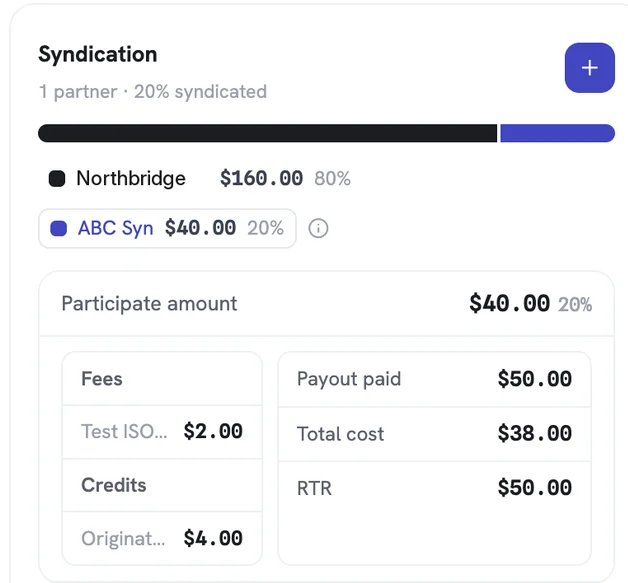
Payment calendar, syndication, paybacks and fees for each deal after it funds.
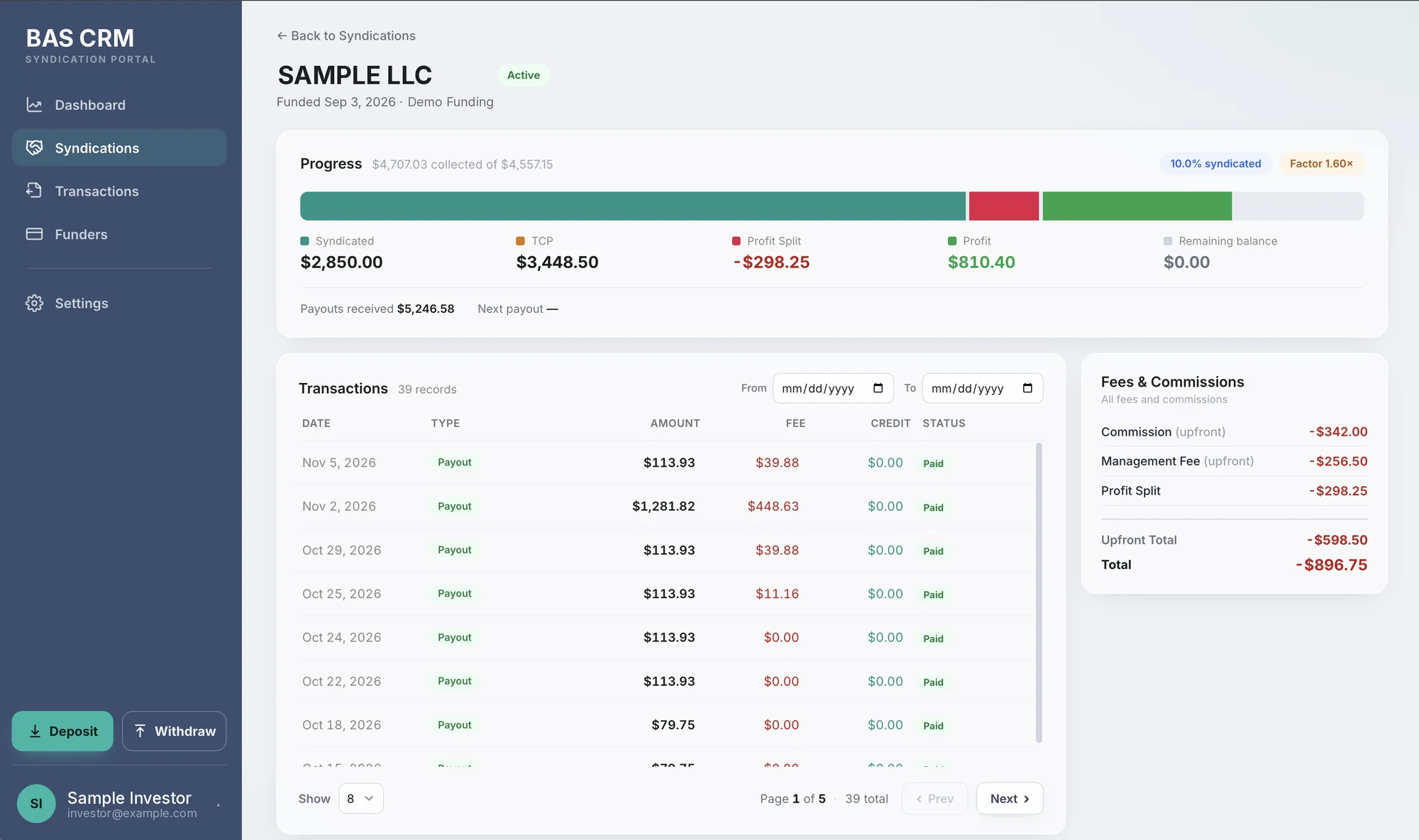
Each syndicator gets their own portal with deal progress, payouts, fees and every transaction.
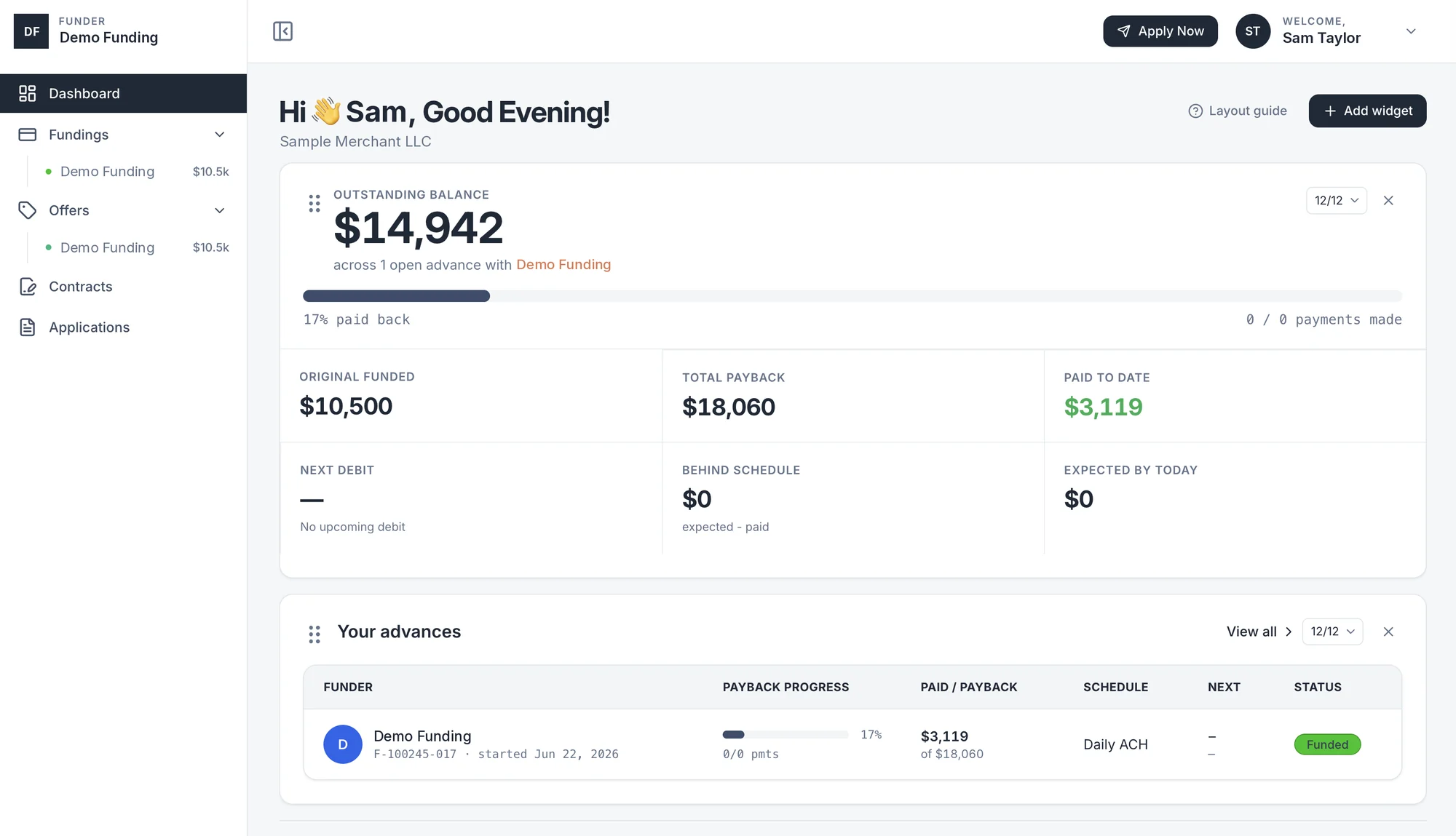
Each merchant gets a portal with their balance, payback progress, contracts and offers, so fewer calls come to your team.
Bank statements are parsed automatically, and every transaction is traced back to its line on the statement.
Each file is scored, graded and matched with an offer using the criteria you set in your account.
After funding, the payment calendar, syndication, paybacks and fees are tracked on every deal.
Bank statements read automatically, no retyping.
Every file scored against your own funding box.
Matched with an offer from the criteria you set.
Each parsed transaction traced to its statement line.
Every funded deal’s payments, day by day.
Participants, paybacks and fees on each deal.
Book a demo and we’ll walk you through it.
BAS CRM works with these payment, banking, underwriting and communication tools, and checks the public records funders rely on.
Product names and trademarks belong to their owners. Public-record sources are data sources BAS CRM checks, not partners.
Bookkeeping is billed by the hour, and your rate drops as your weekly hours grow. Tax and business services are priced per service.
| 40+ hours On site option free of charge | $60 |
| 30–39 hours | $63 |
| 25–29 hours | $65 |
| 20–24 hours | $70 |
| 15–19 hours | $75 |
| 11–14 hours | $80 |
| 6–10 hours | $85 |
| 0–5 hours | $90 |
| Review / manager hours | $120 |
| Sales tax, bookkeeping client | $175 |
| Sales tax, non-bookkeeping client | $325 |
| Business year-end taxes | from $1,950 |
| Business year-end taxes, 1 partner | from $2,350 |
| Each additional partner | from $275 |
| Personal year-end taxes | from $350 |
| Full-year write-up (previous year) | from $1,900 |
| Partner / manager consulting, hourly | from $350 / $275 |
| State and federal notices / audit, hourly | $115 |
| Corporation formation | from $600 |
| Cash analysis | $2,000 ($1,000–$4,000) |
“From” prices are starting prices. The final price depends on the size and complexity of the work.
Book a call and we’ll review your book and tell you which services and hours fit.
MCA industry insight, bookkeeping and accounting advice, and plain-English tax guides from the BAS team.
MCA insight, bookkeeping tips and tax guides from the BAS team, straight to your inbox.
There is a peculiar irony at the heart of every successful merchant cash advance company: the very growth its founders dream of is often what nearly destroys it. This paradox plays out with remarkable consistency. A small team, two or three people working from a modest office, builds something that works. The CRM handles the volume. Spreadsheets track deals and daily payments well enough. Then volume triples, deals close faster, syndicators come calling, and what once felt like a well-oiled machine starts grinding against itself. Reconciliations that took an afternoon now consume days. Syndicator payouts lag behind collections. Team members duplicate each other’s work or, worse, leave critical tasks undone because everyone assumed someone else was handling them. The founders, who used to spend their days funding new deals and building relationships, now spend them firefighting.
This is not failure. It is something more interesting: the natural consequence of success meeting its own limitations. What serves a $5 million portfolio beautifully will buckle under a $50 million one. The difference between companies that plateau and companies that break through to the next level is rarely about talent or ambition. It is almost always about infrastructure.
Consider what actually breaks when MCA companies scale. Most do not collapse because they funded bad deals. They stumble because their internal systems, designed for a simpler era, cannot support a more complex present. The cracks appear in predictable places. Financial reporting is usually the first casualty. Early-stage funders get by on Google Sheets, basic bookkeeping, manual reconciliations. These tools are not wrong; they are merely insufficient at scale. When the number of merchants, syndicators, and advances multiplies, a single missed entry can cascade into inaccurate financial statements, strained relationships with syndicators, and the slow erosion of investor trust. Process control is the second vulnerability. Tasks that were once intuitive, handled by whoever happened to be nearby, now require explicit ownership and documentation. Without clear internal controls (who approves, who reconciles, who verifies), errors slip through unnoticed. Sometimes fraud does too. The third weakness is visibility itself. You cannot manage what you cannot see. When daily cash flow, default rates, and syndicator balances require hours of digging to surface, decisions get made in the dark. And decisions made in the dark have a way of looking foolish in the light.
At Better Accounting Solutions, we encounter these challenges constantly in companies that are, by most measures, thriving. Talented people, profitable operations, genuine momentum. Their systems simply have not kept pace with their ambition. The encouraging news is that this moment of strain, properly recognized, can become a turning point rather than a dead end.
The solution is not to work harder at what you have been doing. It is to change how you operate. Standardization, for instance, sounds dull until you realize it is the foundation of everything else. In the early days, flexibility is a genuine advantage. As you scale, consistency becomes more valuable. Standardize your chart of accounts, your naming conventions, your reconciliation methods, your reporting cadence. Everyone working from the same playbook beats everyone improvising their own. Separating duties matters more than most founders initially appreciate. No single person should control every part of a transaction. One staff member initiates payments; another reconciles them. One prepares financial statements; another reviews and approves. These boundaries are not bureaucracy for its own sake. They prevent honest mistakes and protect against dishonest ones. Automation, done intelligently, amplifies what your people can do. Integrated systems connecting your CRM, accounting software, and ACH processors mean that daily payments, collections, and RTR updates align automatically. Manual uploads disappear. Your staff can spend time on analysis instead of data entry. And perhaps most importantly, you must learn to forecast cash flow rather than simply record it. Fast-growing MCA operations fall into reactive mode with alarming ease, forever chasing yesterday’s numbers. True scaling requires financial models that look forward, anticipating capital needs weeks or months ahead. That visibility keeps you agile. It keeps you investor-ready.
When volume surges, clarity becomes everything. Strong internal reporting is not just about compliance, though compliance matters. It is about how you steer the ship. An MCA operation’s financial heartbeat depends on knowing, at any moment, where money is flowing, what capital remains deployed, how repayment behavior is shifting. The faster you spot trends forming, the faster you can respond: adjusting advance sizes, tightening collections policies, rebalancing syndication exposure before small problems become large ones. Firms that lack this visibility find themselves perpetually reacting. They learn about performance only in hindsight, after shortfalls or liquidity squeezes have already hit. The companies that scale effectively build systems where accuracy and timeliness become reflexive, not heroic.
There is another dimension to all this that founders sometimes underestimate: credibility. As portfolios expand, scrutiny from investors, auditors, and potential acquirers intensifies. Documentation that once seemed optional (signed syndicator agreements, precise RTR recognition, clear merchant performance records) becomes the foundation of trust. If you ever want to attract institutional funding, that trust must be demonstrable on paper. Clean, GAAP-compliant books do not just protect you from trouble. They make you more valuable. Audits go faster. Valuations strengthen. Investor onboarding smooths out. Many firms discover that once their accounting achieves proper structure, opportunities begin materializing that were previously out of reach: new lines of credit, stronger partnerships, greater confidence from the very funders who once kept them at arm’s length.
There comes a moment in every MCA company’s evolution when hustle alone stops being enough. Processes must replace instincts. Systems must replace improvisation. This is not a loss of the entrepreneurial spirit that built the company. It is the necessary evolution from founder-driven to professionally managed. Think of it this way: scaling is not about building a bigger engine. It is about tuning the engine so it can run at higher speeds without burning out.
Growth should be exciting, not exhausting. When your systems are sound, your reports reliable, your finances transparent, growth need not mean chaos. It can mean confidence. The difference between an MCA company that peaks early and one that scales sustainably often comes down to a single question: readiness. Are your systems built for the volume you are chasing? Are your reports investor-ready? Can your team process ten times more transactions without losing accuracy or visibility? If the honest answer is “not yet,” then now is the time to prepare. The stronger your financial foundation, the smoother your next phase of growth will be. Success, after all, is not just about closing more deals. It is about building an operation strong enough to handle them all.
David Roitblat is the founder and CEO of Better Accounting Solutions, an accounting firm based in New York City, and a leading authority in specialized accounting for merchant cash advance companies. To connect with David or schedule a call about working with Better Accounting Solutions, email [email protected].
We’re so happy you found this article informative! Head back to our blog page to learn more tips, tricks, and guidance on accounting to maximize your business’s growth and development.
Book a call or send a message. We reply within one business day.
Tell us about your shop and we’ll reply with next steps.
Effective date: April 23, 2021
Better Accounting Solutions ("us", "we", or "our") operates the https://betteraccountingsolutions.com website (hereinafter referred to as the "Service").
This page informs you of our policies regarding the collection, use, and disclosure of personal data when you use our Service and the choices you have associated with that data.
We use your data to provide and improve the Service. By using the Service, you agree to the collection and use of information in accordance with this policy. Unless otherwise defined in this Privacy Policy, the terms used in this Privacy Policy have the same meanings as in our Terms and Conditions, accessible from https://betteraccountingsolutions.com
We collect several different types of information for various purposes to provide and improve our Service to you.
We do not sell your data under any circumstance.
While using our Service, we may ask you to provide us with certain personally identifiable information that can be used to contact or identify you ("Personal Data"). Personally identifiable information may include, but is not limited to:
We may also collect information on how the Service is accessed and used ("Usage Data"). This Usage Data may include information such as your computer's Internet Protocol address (e.g. IP address), browser type, browser version, the pages of our Service that you visit, the time and date of your visit, the time spent on those pages, unique device identifiers and other diagnostic data.
We use cookies and similar tracking technologies to track the activity on our Service and hold certain information.
Cookies are files with small amount of data which may include an anonymous unique identifier. Cookies are sent to your browser from a website and stored on your device. Tracking technologies also used are beacons, tags, and scripts to collect and track information and to improve and analyze our Service.
You can instruct your browser to refuse all cookies or to indicate when a cookie is being sent. However, if you do not accept cookies, you may not be able to use some portions of our Service. You can learn more how to manage cookies in the Browser Cookies Guide.
Examples of Cookies we use:
Better Accounting Solutions uses the collected data for various purposes:
Your information, including Personal Data, may be transferred to — and maintained on — computers located outside of your state, province, country or other governmental jurisdiction where the data protection laws may differ than those from your jurisdiction.
If you are located outside United States and choose to provide information to us, please note that we transfer the data, including Personal Data, to United States and process it there.
Your consent to this Privacy Policy followed by your submission of such information represents your agreement to that transfer.
Better Accounting Solutions will take all steps reasonably necessary to ensure that your data is treated securely and in accordance with this Privacy Policy and no transfer of your Personal Data will take place to an organization or a country unless there are adequate controls in place including the security of your data and other personal information.
Better Accounting Solutions may disclose your Personal Data in the good faith belief that such action is necessary to:
The security of your data is important to us, but remember that no method of transmission over the Internet, or method of electronic storage is 100% secure. While we strive to use commercially acceptable means to protect your Personal Data, we cannot guarantee its absolute security.
We may employ third party companies and individuals to facilitate our Service ("Service Providers"), to provide the Service on our behalf, to perform Service-related services or to assist us in analyzing how our Service is used.
These third parties have access to your Personal Data only to perform these tasks on our behalf and are obligated not to disclose or use it for any other purpose.
Our Service may contain links to other sites that are not operated by us. If you click on a third party link, you will be directed to that third party's site. We strongly advise you to review the Privacy Policy of every site you visit.
We have no control over and assume no responsibility for the content, privacy policies or practices of any third party sites or services.
Our Service does not address anyone under the age of 18 ("Children").
We do not knowingly collect personally identifiable information from anyone under the age of 18. If you are a parent or guardian and you are aware that your Children has provided us with Personal Data, please contact us. If we become aware that we have collected Personal Data from children without verification of parental consent, we take steps to remove that information from our servers.
We may update our Privacy Policy from time to time. We will notify you of any changes by posting the new Privacy Policy on this page.
We will let you know via email and/or a prominent notice on our Service, prior to the change becoming effective and update the "effective date" at the top of this Privacy Policy.
You are advised to review this Privacy Policy periodically for any changes. Changes to this Privacy Policy are effective when they are posted on this page.
If you have any questions about this Privacy Policy, please contact us: