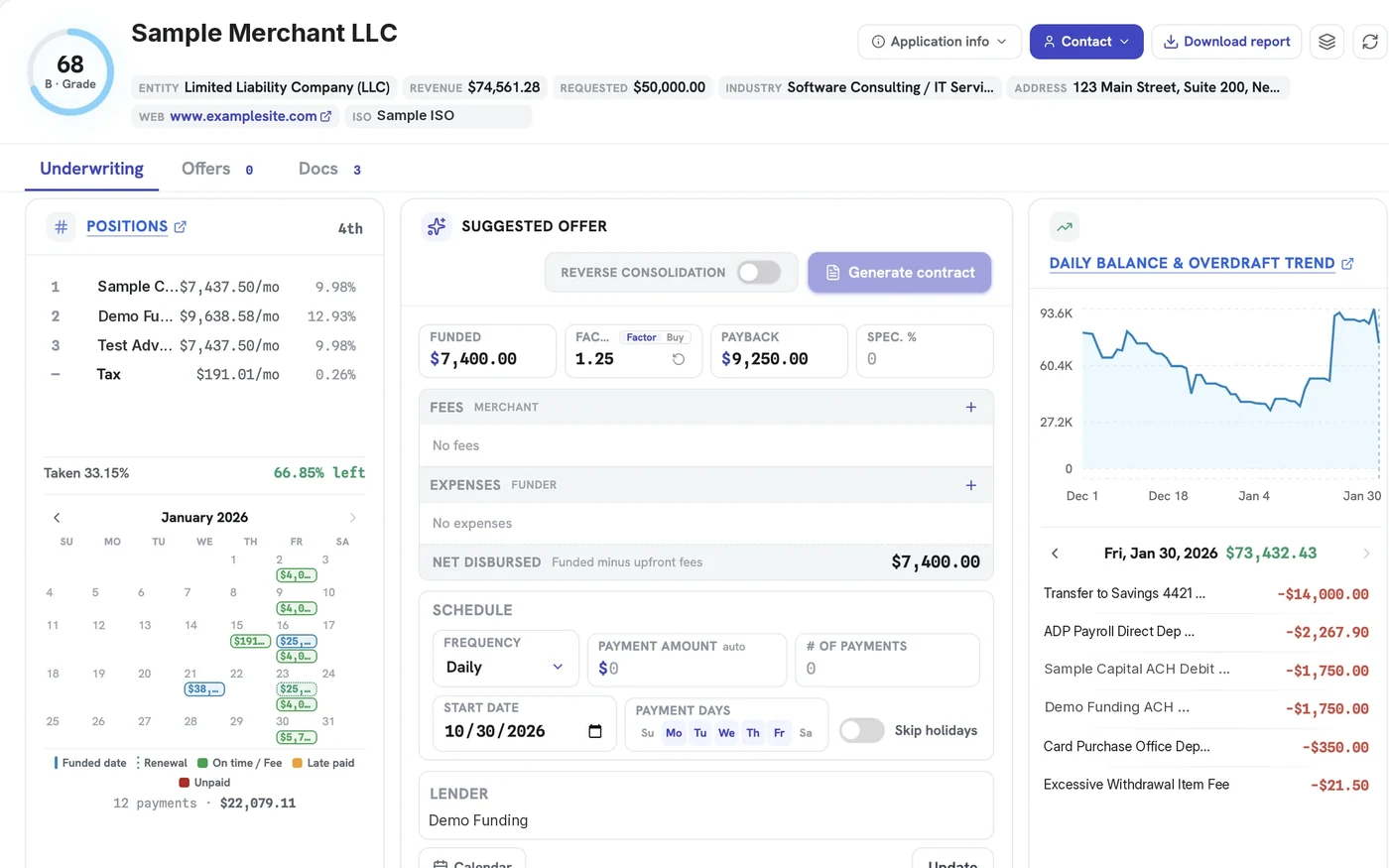
Statement parsing
Bank statements read automatically, no retyping.
Funders, software and service providers across the MCA industry.
Tell us about your shop and we’ll reply within one business day.
We run the books and taxes behind your funding operation, from the first deal to year-end filings.
Clean numbers you can hand to your investors, your syndicators and your CPA.
On a free call, we look at your books, bank accounts and CRM, then confirm how many hours a week your book needs.
We get access to your CRM, bank, ACH system and QuickBooks, and learn how your shop runs.
Daily entries and payments, a monthly close with reports, and year-end taxes, on a set schedule.
| 40+ hours On site option free of charge | $60 |
| 30–39 hours | $63 |
| 25–29 hours | $65 |
| 20–24 hours | $70 |
| 15–19 hours | $75 |
| 11–14 hours | $80 |
| 6–10 hours | $85 |
| 0–5 hours | $90 |
| Review / manager hours | $120 |
| Sales tax, bookkeeping client | $175 |
| Sales tax, non-bookkeeping client | $325 |
| Business year-end taxes | from $1,950 |
| Business year-end taxes, 1 partner | from $2,350 |
| Each additional partner | from $275 |
| Personal year-end taxes | from $350 |
| Full-year write-up (previous year) | from $1,900 |
| Partner / manager consulting, hourly | from $350 / $275 |
| State and federal notices / audit, hourly | $115 |
| Corporation formation | from $600 |
| Cash analysis | $2,000 ($1,000–$4,000) |
“From” prices are starting prices. The final price depends on the size and complexity of the work.
When you work with BAS, real people who know MCA keep your books, not a black box. Here’s the team.




Book a free consultation and we’ll confirm your weekly hours and your rate.
Our team handles the books behind your funding operation, from the first payment on a deal to the last syndicator payout.
We bill bookkeeping by the hour. The more weekly hours your book needs, the lower your rate.
Your rate is set by the total bookkeeping hours you use each week.
Bookkeeping is billed hourly, from $60 to $90 an hour. Tax and business services are priced per service.
Book a free consultation and we’ll confirm your weekly hours and your rate.
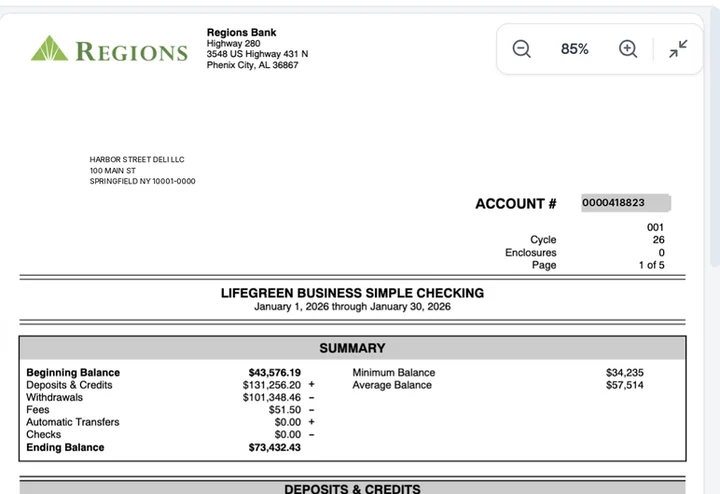
AI reads every bank statement, scores the deal against your box, and tracks it to payoff.
Bank statements are parsed automatically. Each file is then scored, graded and matched with an offer using the criteria you set in your account.
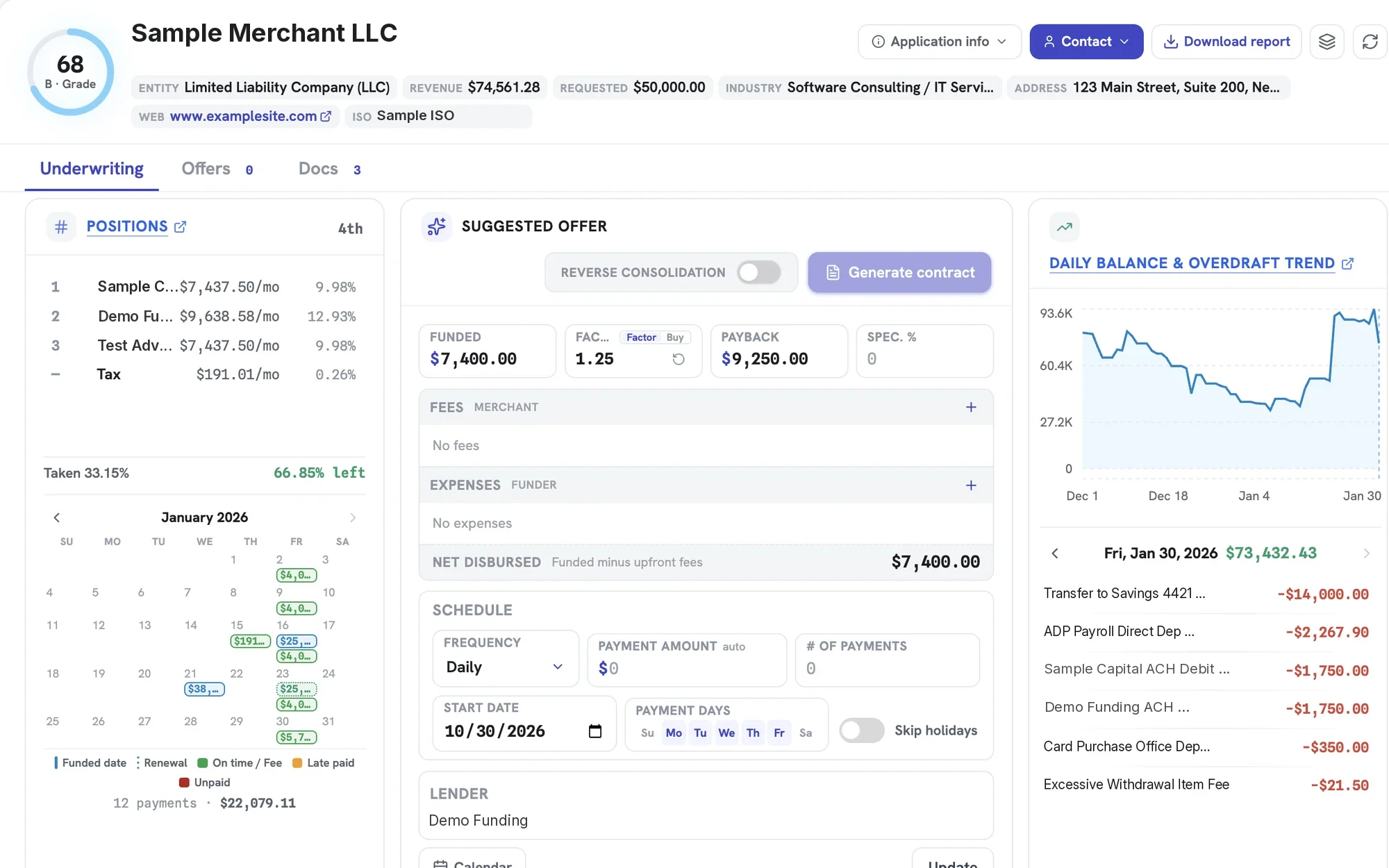
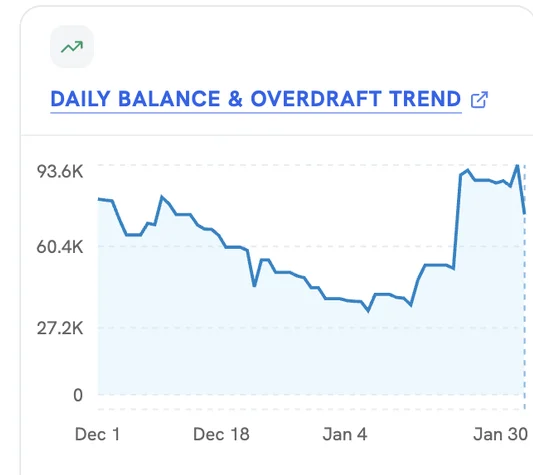
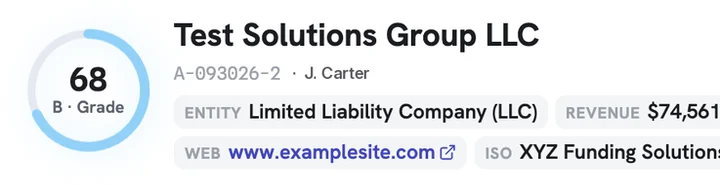
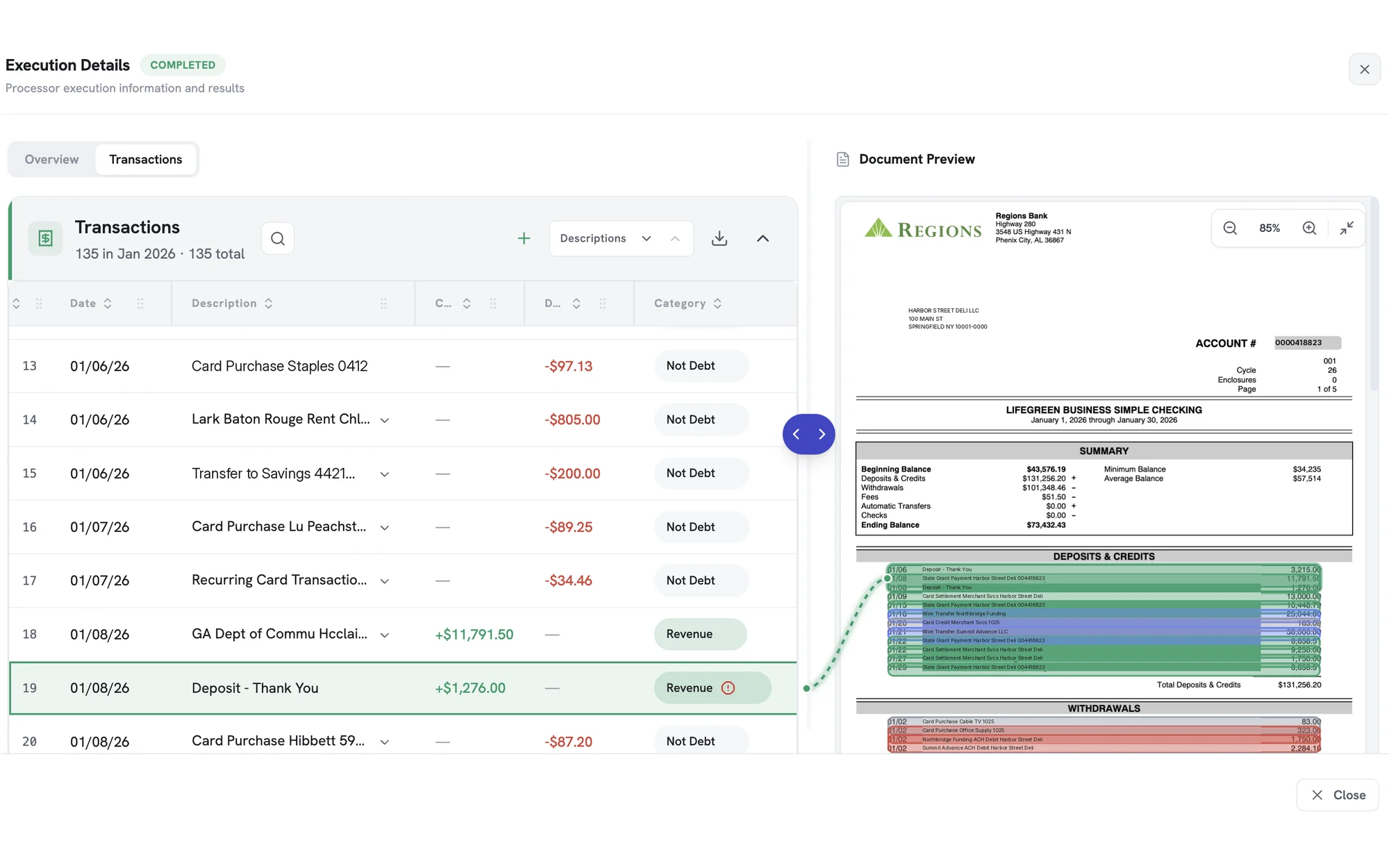
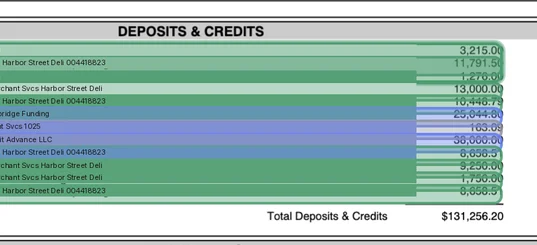
Every parsed transaction is traced back to its line on the bank statement, so you can check the numbers yourself.
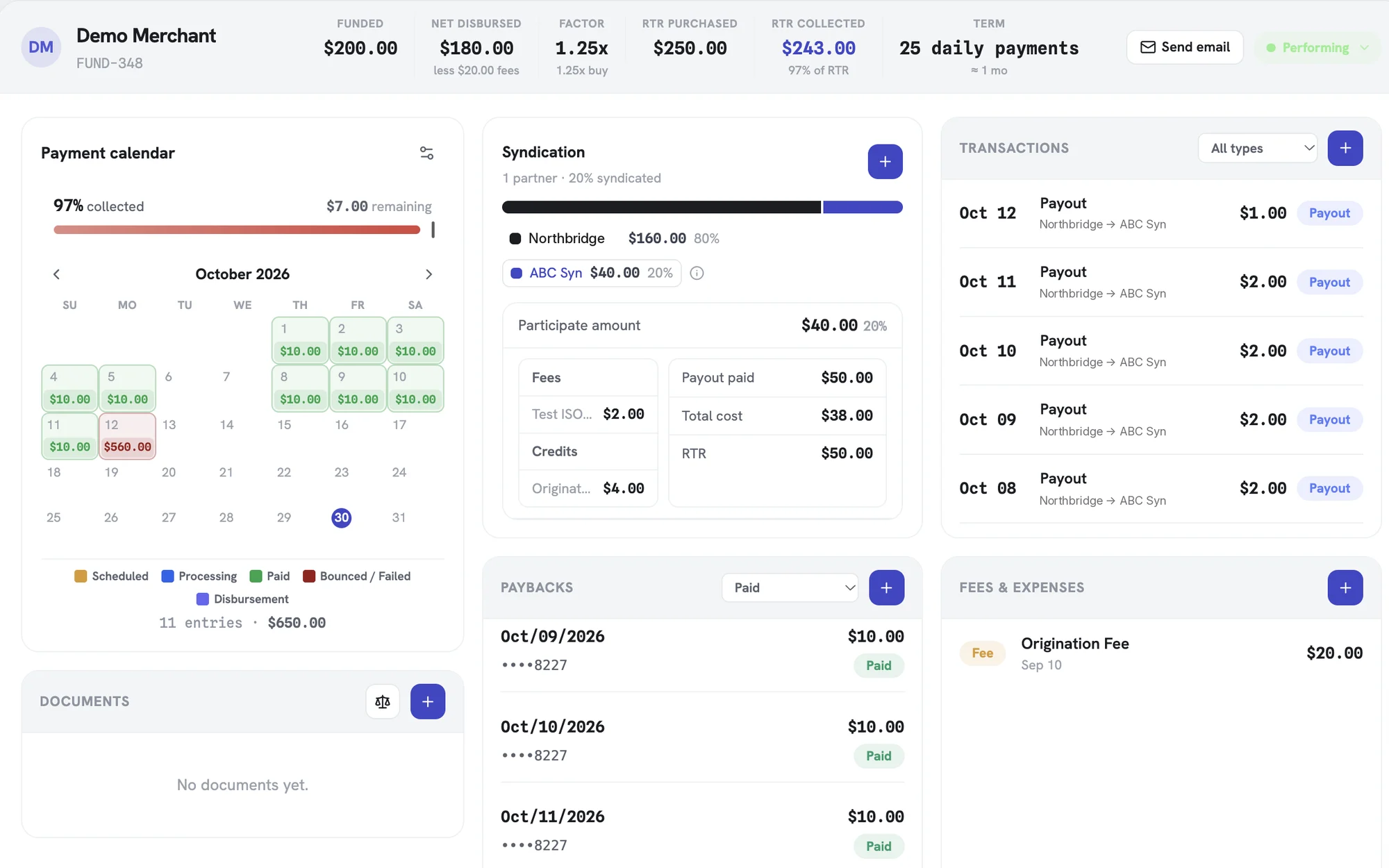
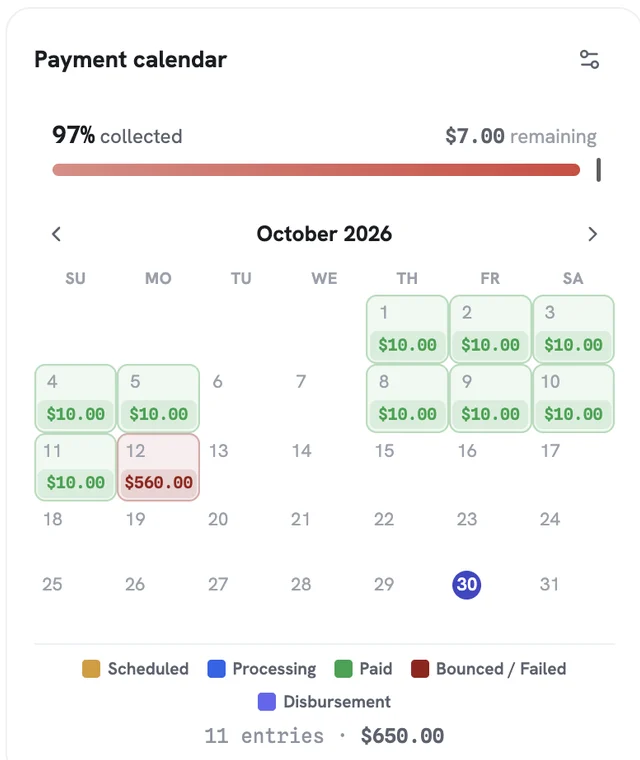
Payment calendar, syndication, paybacks and fees for each deal after it funds.
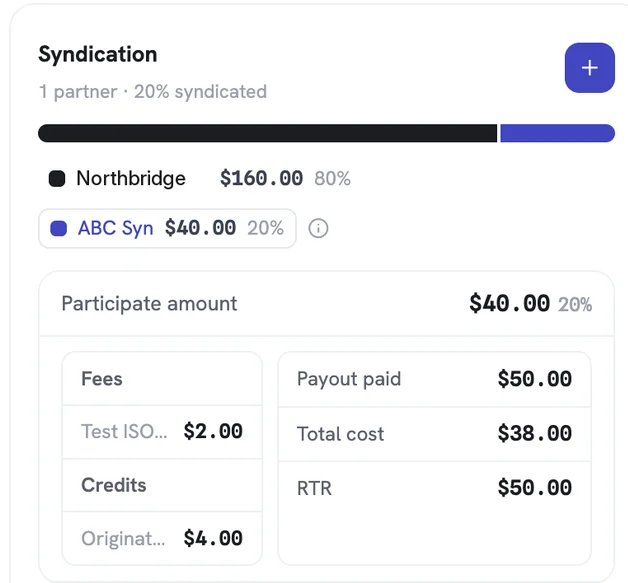
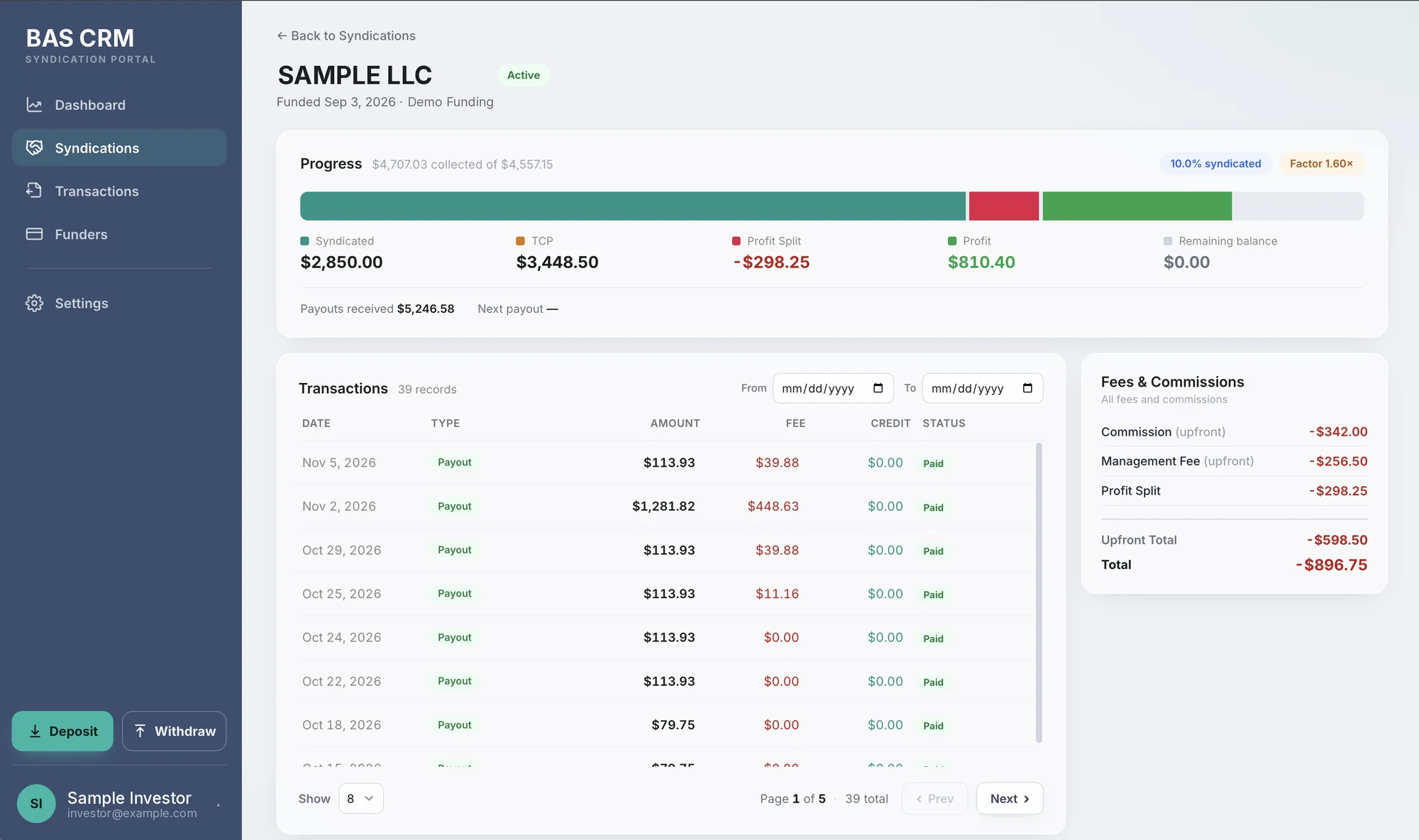
Each syndicator gets their own portal with deal progress, payouts, fees and every transaction.
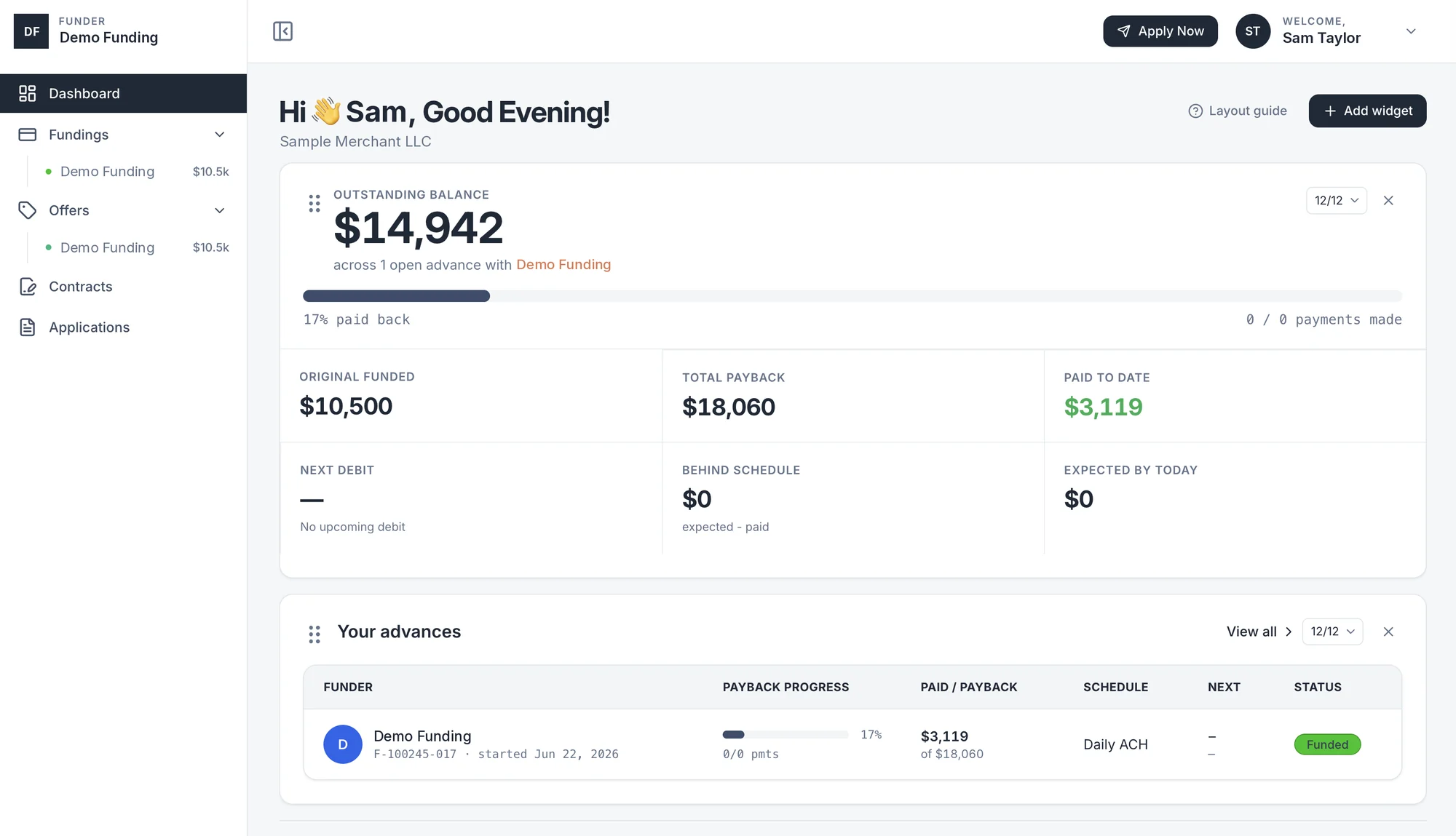
Each merchant gets a portal with their balance, payback progress, contracts and offers, so fewer calls come to your team.
Bank statements are parsed automatically, and every transaction is traced back to its line on the statement.
Each file is scored, graded and matched with an offer using the criteria you set in your account.
After funding, the payment calendar, syndication, paybacks and fees are tracked on every deal.
Bank statements read automatically, no retyping.
Every file scored against your own funding box.
Matched with an offer from the criteria you set.
Each parsed transaction traced to its statement line.
Every funded deal’s payments, day by day.
Participants, paybacks and fees on each deal.
Book a demo and we’ll walk you through it.
BAS CRM works with these payment, banking, underwriting and communication tools, and checks the public records funders rely on.
Product names and trademarks belong to their owners. Public-record sources are data sources BAS CRM checks, not partners.
Bookkeeping is billed by the hour, and your rate drops as your weekly hours grow. Tax and business services are priced per service.
| 40+ hours On site option free of charge | $60 |
| 30–39 hours | $63 |
| 25–29 hours | $65 |
| 20–24 hours | $70 |
| 15–19 hours | $75 |
| 11–14 hours | $80 |
| 6–10 hours | $85 |
| 0–5 hours | $90 |
| Review / manager hours | $120 |
| Sales tax, bookkeeping client | $175 |
| Sales tax, non-bookkeeping client | $325 |
| Business year-end taxes | from $1,950 |
| Business year-end taxes, 1 partner | from $2,350 |
| Each additional partner | from $275 |
| Personal year-end taxes | from $350 |
| Full-year write-up (previous year) | from $1,900 |
| Partner / manager consulting, hourly | from $350 / $275 |
| State and federal notices / audit, hourly | $115 |
| Corporation formation | from $600 |
| Cash analysis | $2,000 ($1,000–$4,000) |
“From” prices are starting prices. The final price depends on the size and complexity of the work.
Book a call and we’ll review your book and tell you which services and hours fit.
MCA industry insight, bookkeeping and accounting advice, and plain-English tax guides from the BAS team.
MCA insight, bookkeeping tips and tax guides from the BAS team, straight to your inbox.
In the fast-paced and ever changing world of cash advance, tax season can often present a labyrinth of compliance and reporting challenges. These challenges are not just bureaucratic hurdles that must be overcome; they also serve as crucial tests of a company’s financial health and operational integrity. Given the intense scrutiny the cash advance industry faces from regulatory bodies, particularly in light of recent industry shaking events, alongside the unique nature of how its financial transactions can be structured, ensuring tax compliance is not just advisable—it’s essential. Let’s discuss frequent speed bumps cash advance companies encounter during tax season, and some solutions for these problems.
One of the most significant stumbling blocks for cash advance businesses lies in the misclassification of the funds they advance to customers. This misstep can lead to serious tax implications, distorting the financial understanding of a company in the eyes of the law. A robust accounting system that accurately differentiates loans, advances, and income is not just a recommendation; it’s a necessity. Each category must be meticulously reported for tax purposes, a task that underscores the importance of seeking guidance from a tax professional well-versed in the nuances and implications of these classifications.
A common oversight among cash advance companies is the inaccurate reporting of income. Whether it’s underreporting or misclassifying earnings, the repercussions can be severe, and include the possibility of triggering an audit or incurring a severe financial penalty. The remedy? An accounting software tailored for the funding industry (such as Orgmeter, MCA-Track, OnyxIQ, Centrex, or LendSaas), capable of automating the calculation and reporting all necessary metrics and income. This ensures not only compliance but also a transparent overview of a company’s financial health that benefits you as well.
Just over 5 years ago, Wayfair was successfully sued by South Dakota for failing to tax online sales even though they had no physical presence in the state, beginning a new era of legal understanding of state tax obligations in the internet and cross-state trade era. The complexity of tax compliance is magnified for cash advance companies operating across state lines, each with its unique tax laws and regulations. This multi-state maze can easily lead to oversight or misunderstanding, risking non-compliance. The solution is twofold: developing a comprehensive compliance checklist for each state and consulting with tax professionals who specialize in navigating these multi-state operations. Together, these strategies form a bulwark against the many possible blind spots of state-specific tax obligations.
Not having the correct documentation and record-keeping on hand can transform a routine tax audit into a nightmare scenario, and cause businesses to be slapped with heavy penalties and fines. To counter this risk, cash advance companies need to maintain meticulous records of all transactions. Experts often recommend businesses conduct regular audits, whether internal or external, to ensure these records are both accurate and will back you up when they are needed.
Perhaps one of the easiest mistakes to avoid is not adequately planning for surprise tax liabilities. Without planning in advance and setting aside sufficient funds to cover these obligations, companies can find themselves in a precarious cash flow situation when taxes are due. A proactive strategy to counter that involves specifically marking off a portion of income in a dedicated account for unforeseen expenditures (tax liabilities included), calculated with an estimated effective tax rate. This approach, developed with the assistance of a tax professional, can prevent the unwelcome surprise of a hefty tax bill when you’re not ready for it.
At the end of the day, tax compliance, while definitely not fun, should not be viewed (just) as a regulatory pain-in-the-butt, but as a way to ensure a cash advance business’s success and longevity. By embracing proactive tax planning and compliance, companies can not only successfully navigate the complexities of tax season but also reinforce the integrity and sustainability of their business and ensure their success and viability for years to come, free from any stress or government microscope.
David Roitblat is the founder and CEO of Better Accounting Solutions, an accounting firm based in New York City, and a leading authority in specialized accounting for merchant cash advance companies. To connect with David or schedule a call about working with Better Accounting Solutions, email [email protected].
We’re so happy you found this article informative! Head back to our blog page to learn more tips, tricks, and guidance on accounting to maximize your business’s growth and development.
Book a call or send a message. We reply within one business day.
Tell us about your shop and we’ll reply with next steps.
Effective date: April 23, 2021
Better Accounting Solutions ("us", "we", or "our") operates the https://betteraccountingsolutions.com website (hereinafter referred to as the "Service").
This page informs you of our policies regarding the collection, use, and disclosure of personal data when you use our Service and the choices you have associated with that data.
We use your data to provide and improve the Service. By using the Service, you agree to the collection and use of information in accordance with this policy. Unless otherwise defined in this Privacy Policy, the terms used in this Privacy Policy have the same meanings as in our Terms and Conditions, accessible from https://betteraccountingsolutions.com
We collect several different types of information for various purposes to provide and improve our Service to you.
We do not sell your data under any circumstance.
While using our Service, we may ask you to provide us with certain personally identifiable information that can be used to contact or identify you ("Personal Data"). Personally identifiable information may include, but is not limited to:
We may also collect information on how the Service is accessed and used ("Usage Data"). This Usage Data may include information such as your computer's Internet Protocol address (e.g. IP address), browser type, browser version, the pages of our Service that you visit, the time and date of your visit, the time spent on those pages, unique device identifiers and other diagnostic data.
We use cookies and similar tracking technologies to track the activity on our Service and hold certain information.
Cookies are files with small amount of data which may include an anonymous unique identifier. Cookies are sent to your browser from a website and stored on your device. Tracking technologies also used are beacons, tags, and scripts to collect and track information and to improve and analyze our Service.
You can instruct your browser to refuse all cookies or to indicate when a cookie is being sent. However, if you do not accept cookies, you may not be able to use some portions of our Service. You can learn more how to manage cookies in the Browser Cookies Guide.
Examples of Cookies we use:
Better Accounting Solutions uses the collected data for various purposes:
Your information, including Personal Data, may be transferred to — and maintained on — computers located outside of your state, province, country or other governmental jurisdiction where the data protection laws may differ than those from your jurisdiction.
If you are located outside United States and choose to provide information to us, please note that we transfer the data, including Personal Data, to United States and process it there.
Your consent to this Privacy Policy followed by your submission of such information represents your agreement to that transfer.
Better Accounting Solutions will take all steps reasonably necessary to ensure that your data is treated securely and in accordance with this Privacy Policy and no transfer of your Personal Data will take place to an organization or a country unless there are adequate controls in place including the security of your data and other personal information.
Better Accounting Solutions may disclose your Personal Data in the good faith belief that such action is necessary to:
The security of your data is important to us, but remember that no method of transmission over the Internet, or method of electronic storage is 100% secure. While we strive to use commercially acceptable means to protect your Personal Data, we cannot guarantee its absolute security.
We may employ third party companies and individuals to facilitate our Service ("Service Providers"), to provide the Service on our behalf, to perform Service-related services or to assist us in analyzing how our Service is used.
These third parties have access to your Personal Data only to perform these tasks on our behalf and are obligated not to disclose or use it for any other purpose.
Our Service may contain links to other sites that are not operated by us. If you click on a third party link, you will be directed to that third party's site. We strongly advise you to review the Privacy Policy of every site you visit.
We have no control over and assume no responsibility for the content, privacy policies or practices of any third party sites or services.
Our Service does not address anyone under the age of 18 ("Children").
We do not knowingly collect personally identifiable information from anyone under the age of 18. If you are a parent or guardian and you are aware that your Children has provided us with Personal Data, please contact us. If we become aware that we have collected Personal Data from children without verification of parental consent, we take steps to remove that information from our servers.
We may update our Privacy Policy from time to time. We will notify you of any changes by posting the new Privacy Policy on this page.
We will let you know via email and/or a prominent notice on our Service, prior to the change becoming effective and update the "effective date" at the top of this Privacy Policy.
You are advised to review this Privacy Policy periodically for any changes. Changes to this Privacy Policy are effective when they are posted on this page.
If you have any questions about this Privacy Policy, please contact us: