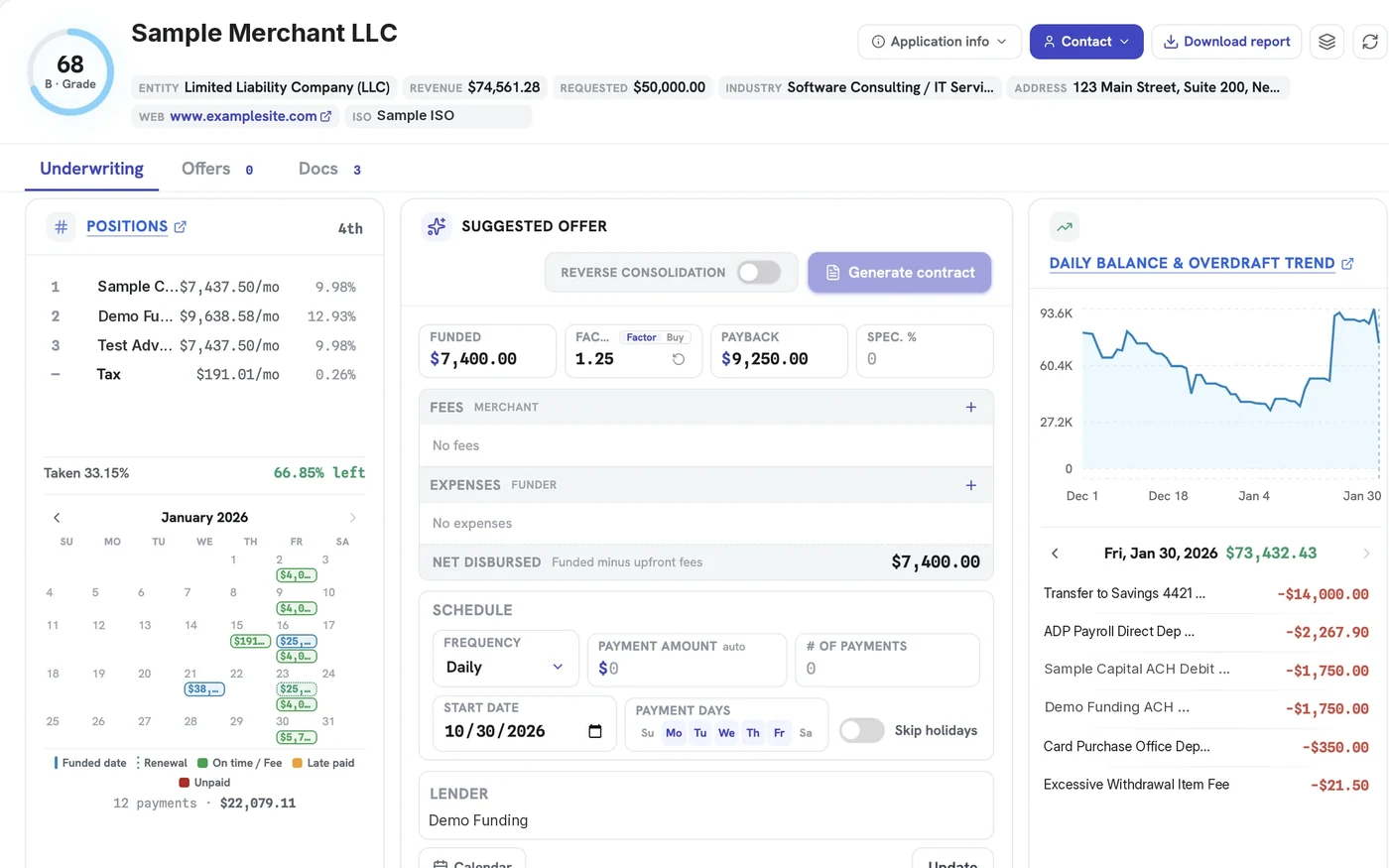
Statement parsing
Bank statements read automatically, no retyping.
Funders, software and service providers across the MCA industry.
Tell us about your shop and we’ll reply within one business day.
We run the books and taxes behind your funding operation, from the first deal to year-end filings.
Clean numbers you can hand to your investors, your syndicators and your CPA.
On a free call, we look at your books, bank accounts and CRM, then confirm how many hours a week your book needs.
We get access to your CRM, bank, ACH system and QuickBooks, and learn how your shop runs.
Daily entries and payments, a monthly close with reports, and year-end taxes, on a set schedule.
| 40+ hours On site option free of charge | $60 |
| 30–39 hours | $63 |
| 25–29 hours | $65 |
| 20–24 hours | $70 |
| 15–19 hours | $75 |
| 11–14 hours | $80 |
| 6–10 hours | $85 |
| 0–5 hours | $90 |
| Review / manager hours | $120 |
| Sales tax, bookkeeping client | $175 |
| Sales tax, non-bookkeeping client | $325 |
| Business year-end taxes | from $1,950 |
| Business year-end taxes, 1 partner | from $2,350 |
| Each additional partner | from $275 |
| Personal year-end taxes | from $350 |
| Full-year write-up (previous year) | from $1,900 |
| Partner / manager consulting, hourly | from $350 / $275 |
| State and federal notices / audit, hourly | $115 |
| Corporation formation | from $600 |
| Cash analysis | $2,000 ($1,000–$4,000) |
“From” prices are starting prices. The final price depends on the size and complexity of the work.
When you work with BAS, real people who know MCA keep your books, not a black box. Here’s the team.




Book a free consultation and we’ll confirm your weekly hours and your rate.
Our team handles the books behind your funding operation, from the first payment on a deal to the last syndicator payout.
We bill bookkeeping by the hour. The more weekly hours your book needs, the lower your rate.
Your rate is set by the total bookkeeping hours you use each week.
Bookkeeping is billed hourly, from $60 to $90 an hour. Tax and business services are priced per service.
Book a free consultation and we’ll confirm your weekly hours and your rate.
AI reads every bank statement, scores the deal against your box, and tracks it to payoff.
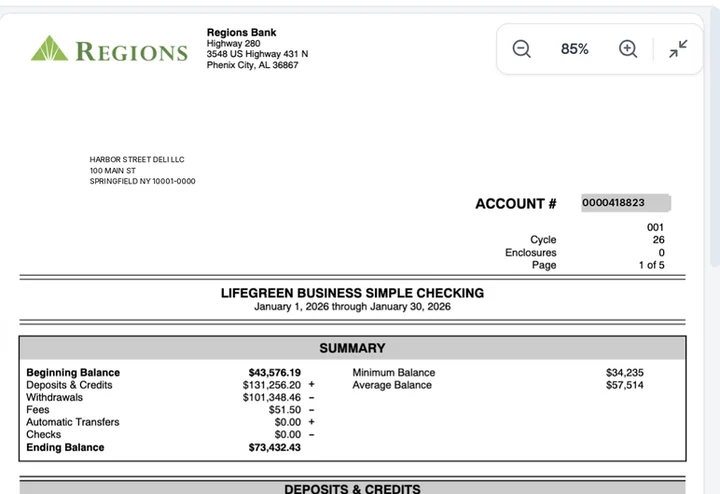
Bank statements are parsed automatically. Each file is then scored, graded and matched with an offer using the criteria you set in your account.
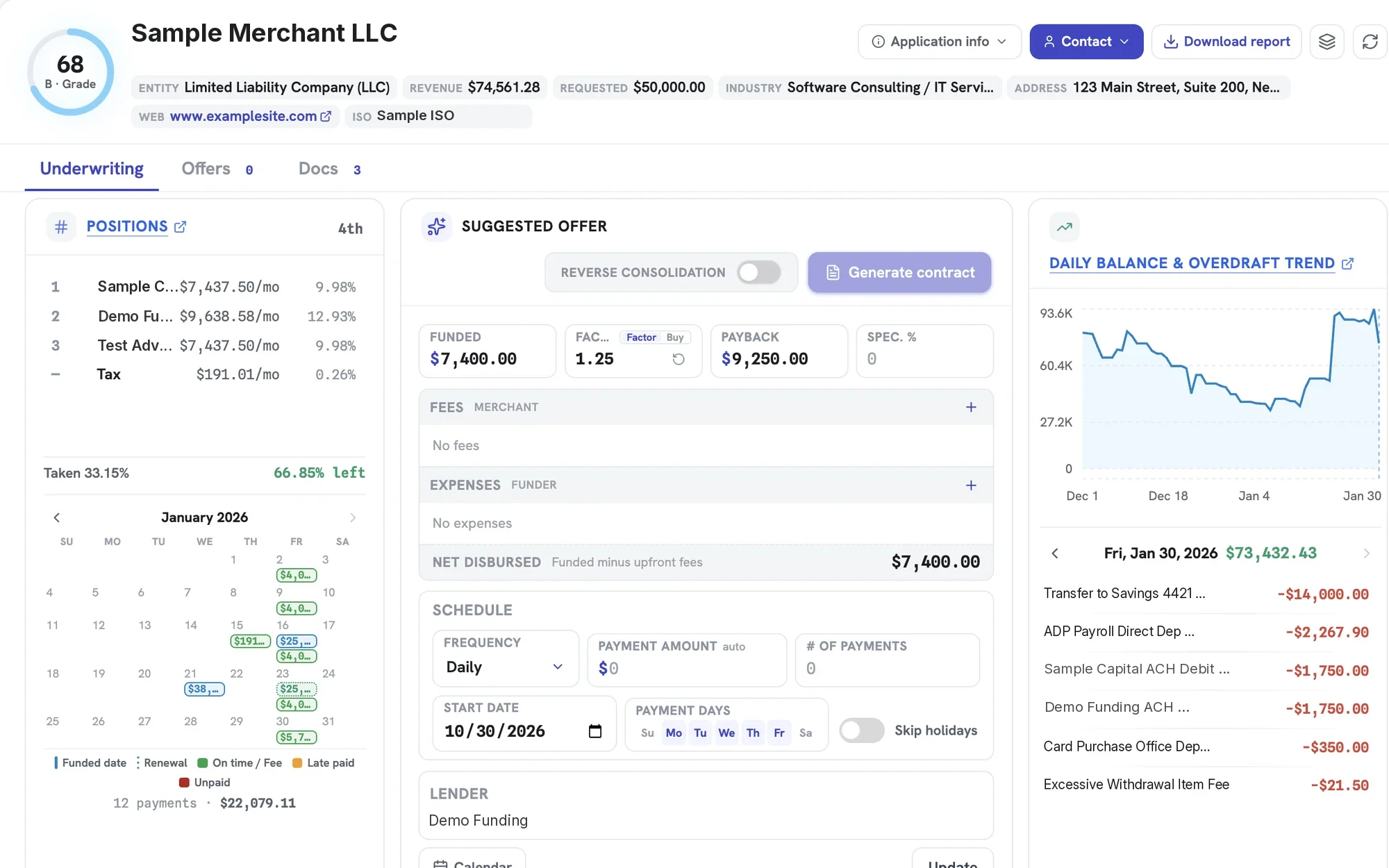
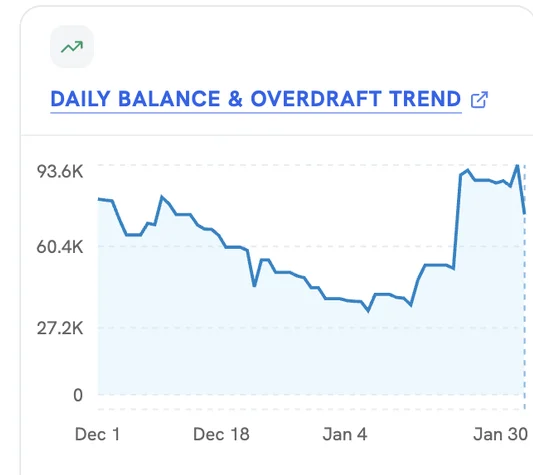
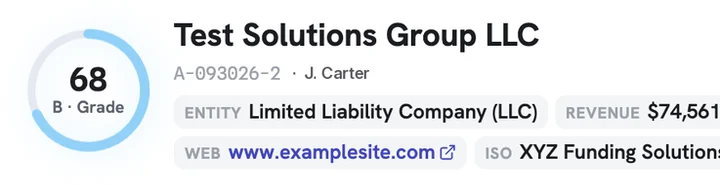
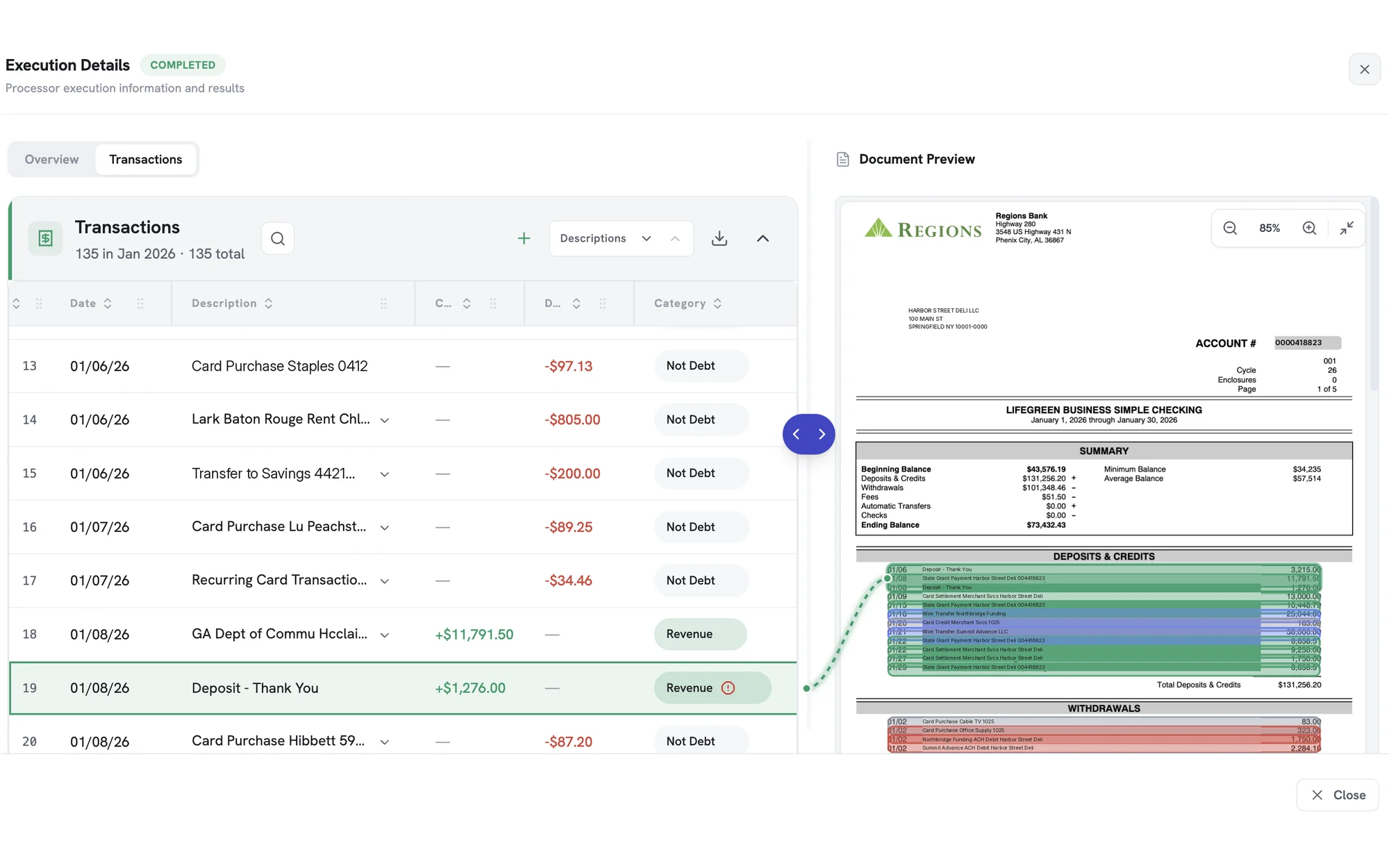
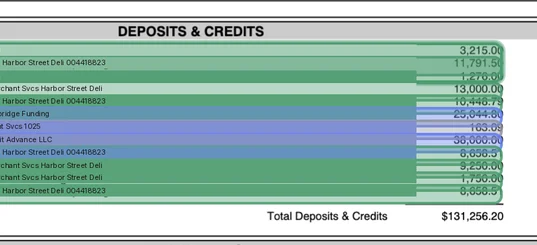
Every parsed transaction is traced back to its line on the bank statement, so you can check the numbers yourself.
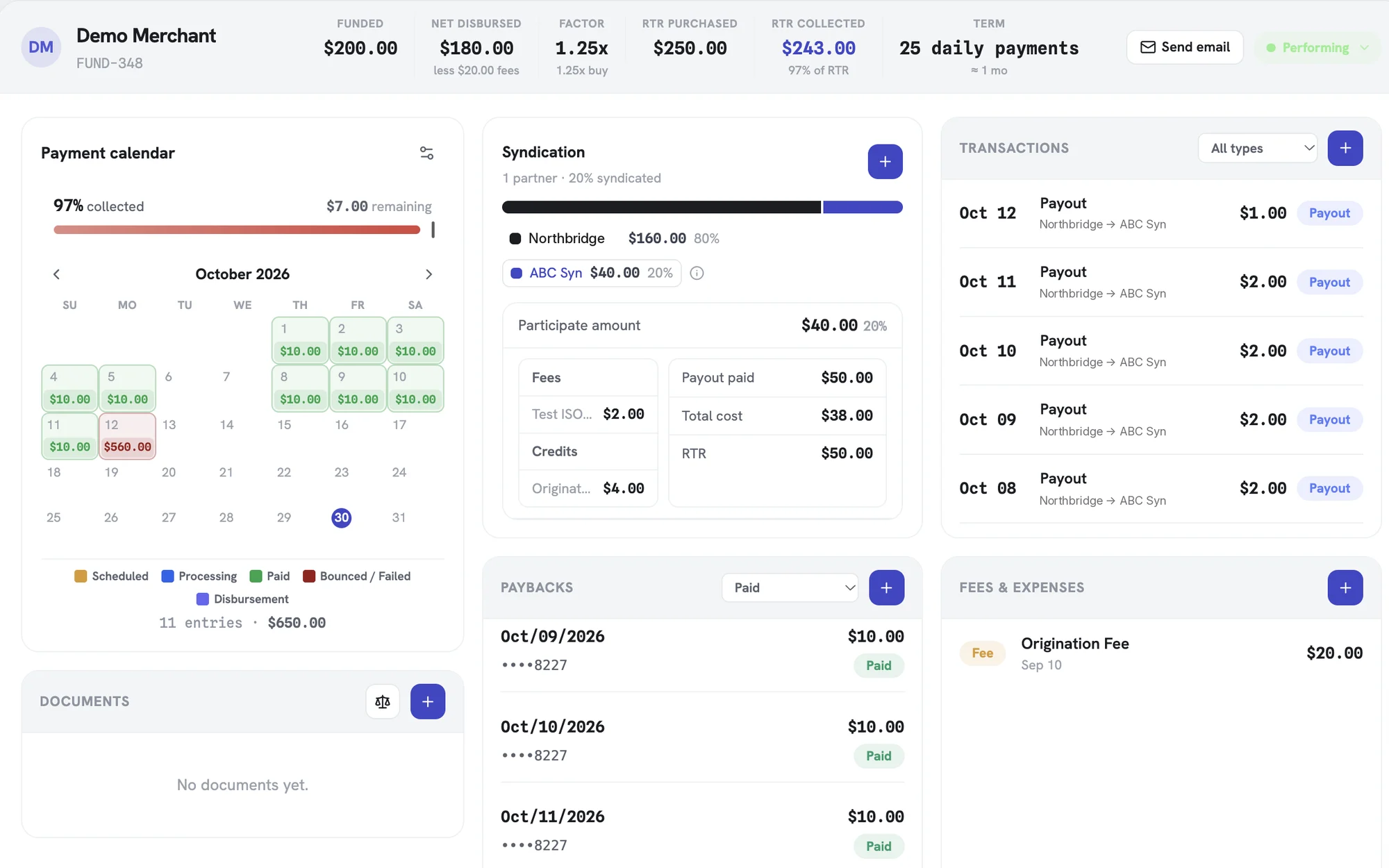
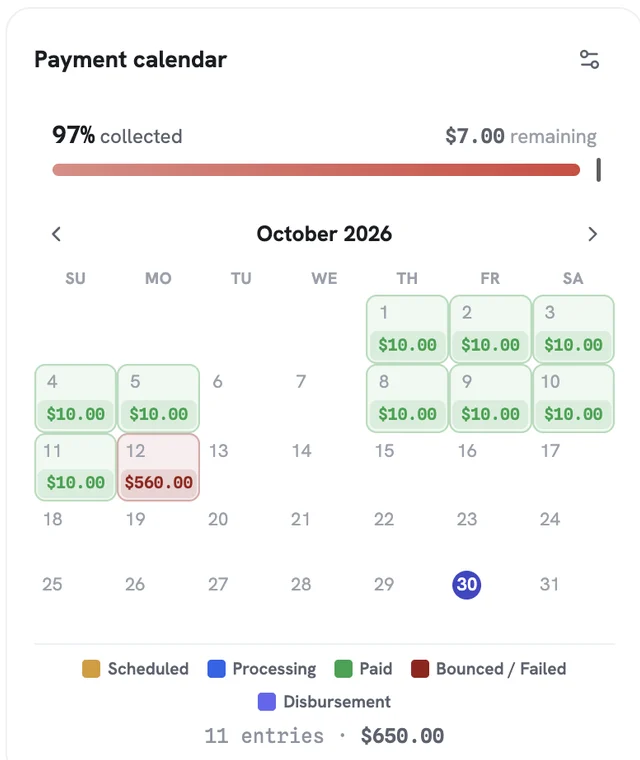
Payment calendar, syndication, paybacks and fees for each deal after it funds.
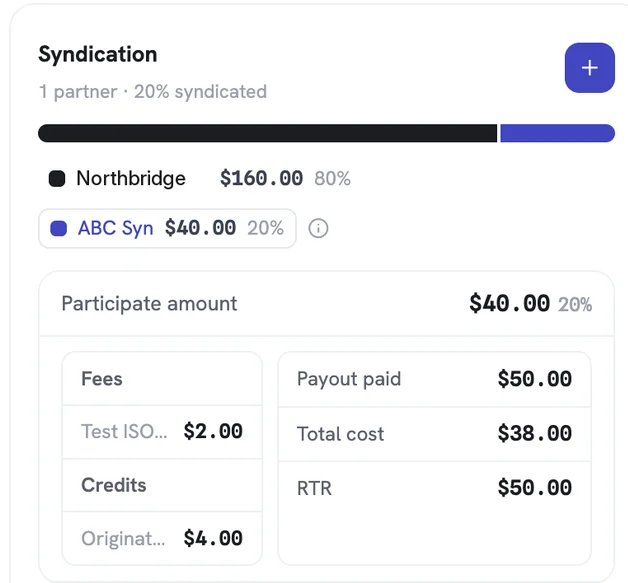
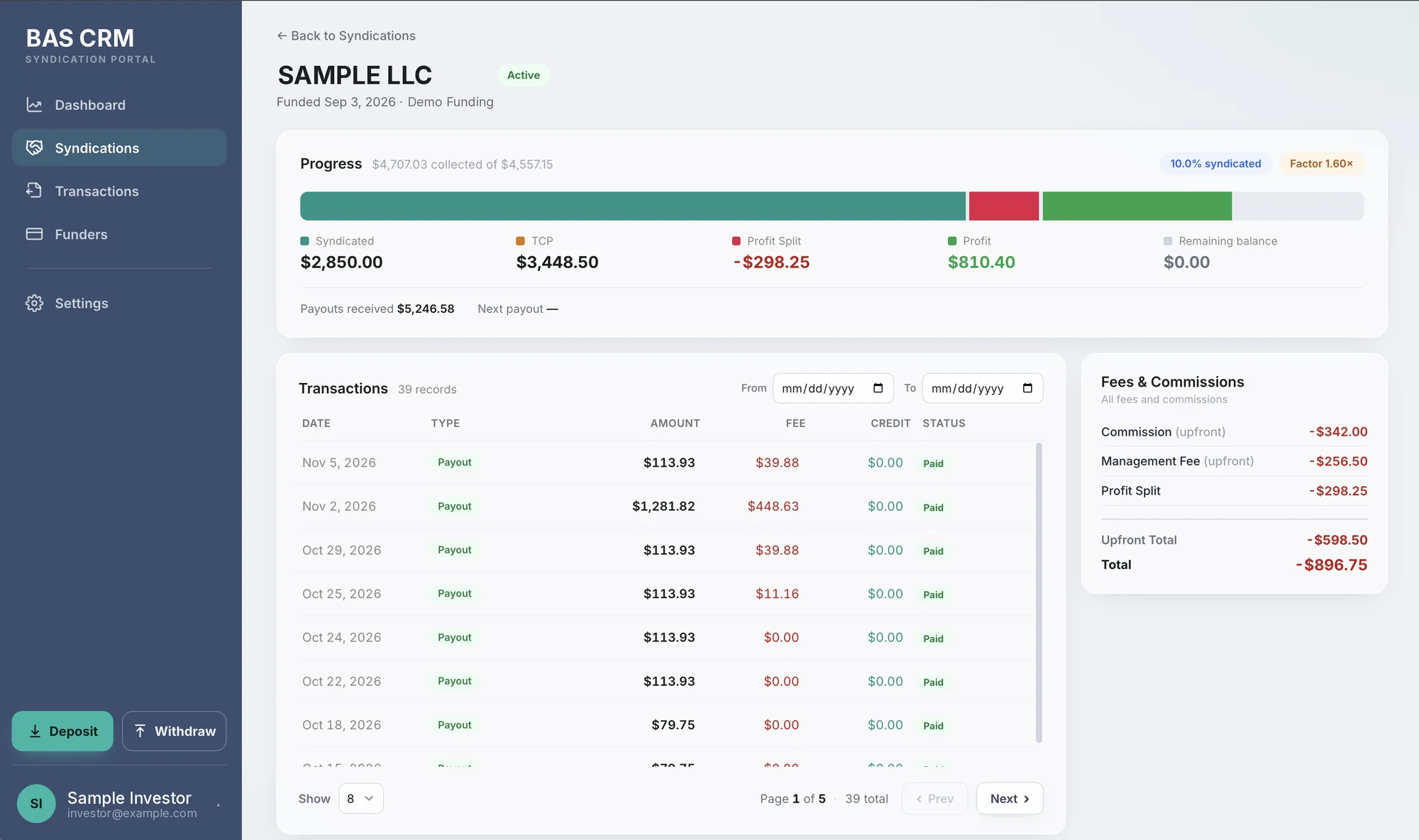
Each syndicator gets their own portal with deal progress, payouts, fees and every transaction.
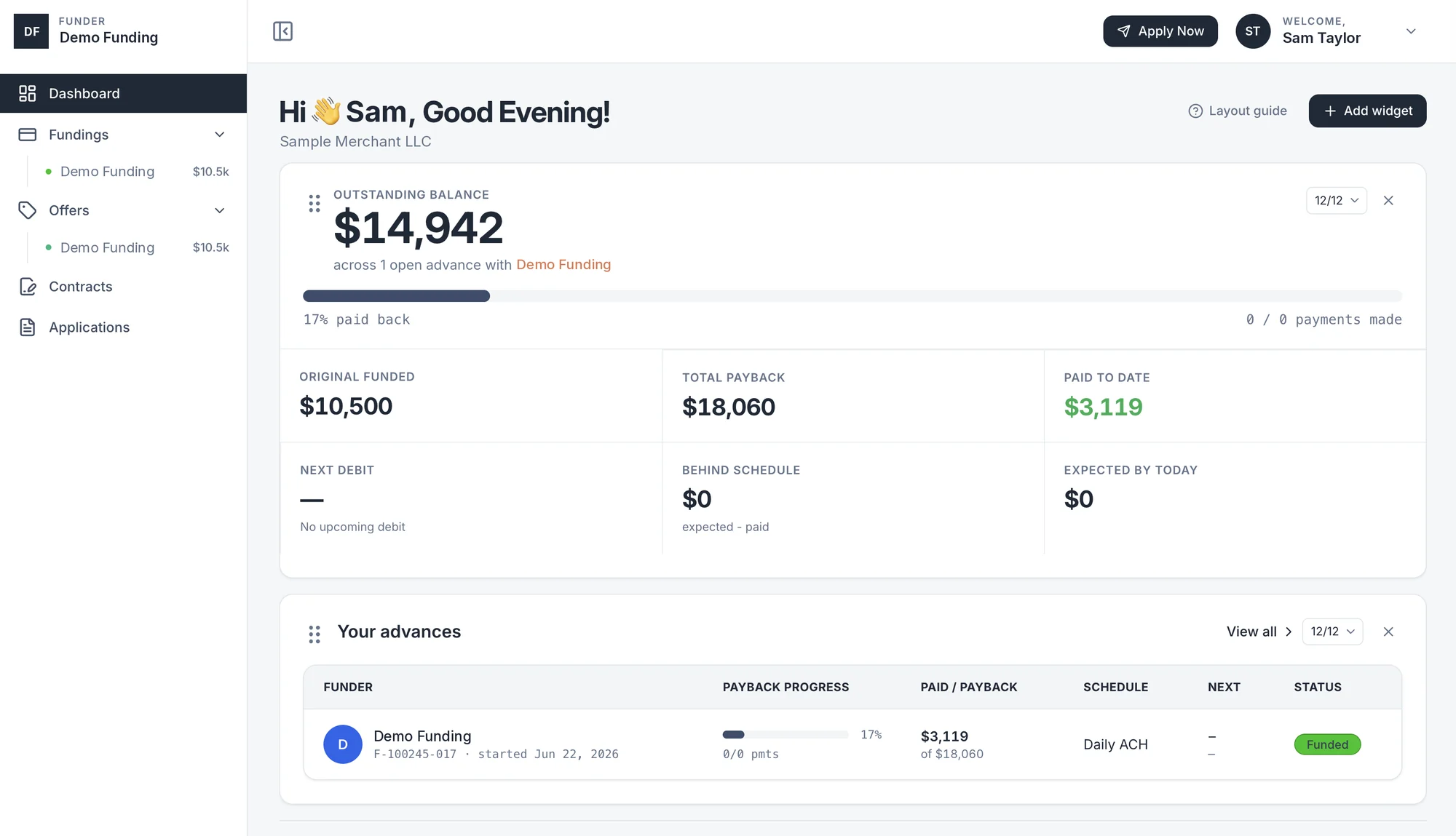
Each merchant gets a portal with their balance, payback progress, contracts and offers, so fewer calls come to your team.
Bank statements are parsed automatically, and every transaction is traced back to its line on the statement.
Each file is scored, graded and matched with an offer using the criteria you set in your account.
After funding, the payment calendar, syndication, paybacks and fees are tracked on every deal.
Bank statements read automatically, no retyping.
Every file scored against your own funding box.
Matched with an offer from the criteria you set.
Each parsed transaction traced to its statement line.
Every funded deal’s payments, day by day.
Participants, paybacks and fees on each deal.
Book a demo and we’ll walk you through it.
BAS CRM works with these payment, banking, underwriting and communication tools, and checks the public records funders rely on.
Product names and trademarks belong to their owners. Public-record sources are data sources BAS CRM checks, not partners.
Bookkeeping is billed by the hour, and your rate drops as your weekly hours grow. Tax and business services are priced per service.
| 40+ hours On site option free of charge | $60 |
| 30–39 hours | $63 |
| 25–29 hours | $65 |
| 20–24 hours | $70 |
| 15–19 hours | $75 |
| 11–14 hours | $80 |
| 6–10 hours | $85 |
| 0–5 hours | $90 |
| Review / manager hours | $120 |
| Sales tax, bookkeeping client | $175 |
| Sales tax, non-bookkeeping client | $325 |
| Business year-end taxes | from $1,950 |
| Business year-end taxes, 1 partner | from $2,350 |
| Each additional partner | from $275 |
| Personal year-end taxes | from $350 |
| Full-year write-up (previous year) | from $1,900 |
| Partner / manager consulting, hourly | from $350 / $275 |
| State and federal notices / audit, hourly | $115 |
| Corporation formation | from $600 |
| Cash analysis | $2,000 ($1,000–$4,000) |
“From” prices are starting prices. The final price depends on the size and complexity of the work.
Book a call and we’ll review your book and tell you which services and hours fit.
MCA industry insight, bookkeeping and accounting advice, and plain-English tax guides from the BAS team.
MCA insight, bookkeeping tips and tax guides from the BAS team, straight to your inbox.
Most MCA companies pour extraordinary energy into acquisition. They chase new files, negotiate with brokers, refine their pitch, and work hard to stand out in a crowded market. This makes sense. Without new deals, there is no business. But acquisition alone does not create stability. Stability comes from the merchants who return.
Renewals are not a softer version of new deals. They are the backbone of sustainable growth. The economics are straightforward: a renewing merchant costs less to acquire, repays more predictably, and requires less hand-holding than a first-time borrower. Yet many funders treat renewals as a pleasant surprise rather than a strategic priority. The companies that mature gracefully understand something different. They understand that long-term merchant relationships are assets, not accidents.
A broker at a mid-sized firm once told me about a call she took late one afternoon from a restaurant owner she had funded six months earlier. He was behind on a project and wanted to talk through his repayment schedule. The conversation lasted fifteen minutes. Nothing dramatic happened. No restructuring, no dispute, no crisis. But when he hung up, he said something she remembered for years: “You’re the only funder who talks to me like a person, not a ticket.” Three months later, he renewed. Not because the rates were the lowest, but because the relationship felt steady, human, and fair.
This is how loyalty forms in the MCA world. Not through marketing, but through moments.
Building those moments starts with how you communicate. Merchants lead busy, unpredictable lives. Their days rarely follow clean patterns. When they call their funder, they need clarity, not scripted reassurance. They want someone who understands where their business stands. A roofing contractor in Arizona faces different pressures than a retail shop in Manhattan. Cash flow rhythms differ. Margins differ. Risks differ. When a funder can speak to those specifics, trust begins to form. Trust does not come from charm. It comes from being understood.
Persistence builds the next layer. Funders sometimes underestimate how closely merchants observe reliability. A merchant might not mention it when a broker forgets a promised check-in, but the impression settles quietly. When a question gets answered with care, when a collector calls in a calm manner instead of an urgent tone, the merchant notices. Consistency becomes a form of respect. It signals that the merchant is more than an entry in the CRM.
Education plays a powerful and often overlooked role. Many merchants enter the MCA world with only a rough grasp of how repayment actually works. They know they will pay daily or weekly, but they do not always understand how those payments interact with their sales cycles or cash reserves. A funder who takes five minutes to explain what to expect earns something valuable. An informed merchant is calmer, less reactive, more likely to communicate early when something shifts. Education lowers tension. It also increases their renewal probability because the merchant feels guided rather than pushed.
Even collections shapes renewal behavior. A merchant who experiences difficulty does not forget how they were treated. Shops that approach collections as a relationship function rather than a mechanical chase recover more money and preserve more trust. When a collector says, “Walk me through your last two weeks so we can figure this out,” the merchant feels supported. When a collector launches straight into pressure, the merchant feels cornered. That memory lingers long after the balance is repaid. It becomes the lens through which the merchant decides whether they want to work with that funder again.
A deli owner in Queens once struggled for three weeks after construction on his block slowed foot traffic. He had not missed payments before, and he answered every call. The funder listened, reviewed the account, and offered a temporary reduction without making the merchant beg for it. The merchant finished the term and renewed later that year. More importantly, he began referring other business owners because, in his words, “These people did right by me.” The return on that fifteen-minute conversation extended far beyond the single file.
Companies often assume merchants renew simply because they need more capital. Many do. But need alone does not create loyalty. Merchants choose to return when they feel the funder stood with them rather than over them. That feeling emerges from a series of small interactions. The call returned promptly. The question answered clearly. The email written without jargon. These small acts compound. They create goodwill that can survive a rough patch.
Speed shapes perception too, though not in the superficial way many firms advertise. Merchants do not need an answer in an hour. They need predictability. They need to know the process will move when the funder says it will. Funders who set clear expectations, and honor them consistently, outperform those who boast about speed they achieve only some of the time. Reliability feels like partnership. Unpredictable speed feels like improvisation.
Renewal strategy must also respect the merchant’s timing. Some merchants benefit from renewing early. Others resent being pushed into another deal before completing the current one. A funder who recognizes these differences avoids turning renewal into pressure. When a merchant feels free to say “not yet” without disappointing the funder, they often return willingly when the time is right. Respect builds revenue. Pressure builds churn.
Recordkeeping supports all of this. When notes are entered clearly and consistently, any team member can pick up a merchant conversation without forcing the merchant to repeat their story. Imagine how a merchant feels when they call and the person on the line already understands last month’s issue, last week’s deposit pattern, the context around a late payment. That experience feels personal. It also builds confidence in the funder’s competence. At Better Accounting Solutions, we often see that companies with strong financial documentation habits also tend to have stronger merchant relationships. The same discipline that produces clean books produces clean communication.
As a company grows, these relationship practices need structure behind them. You cannot rely on individual employees to carry the ethos alone. Systems must support it. That means standardized follow-up schedules, consistent outreach during slow periods, customer notes written in a shared language. It means training that emphasizes respect, clarity, and professionalism. It means leadership reinforcing that renewals are earned through service, not through pursuit.
The payoff is significant. Renewal merchants have lower acquisition costs and steadier repayment patterns. They ask fewer basic questions, because they trust the funder. They create fewer surprises, because they communicate earlier. They become the foundation on which the company can build more ambitious strategies. New business drives excitement. Renewals drive efficiency. The most profitable MCA companies treat renewals not as bonus volume, but as central to the business model.
Merchants talk to each other more than funders realize. A good experience travels through neighborhoods, industries, and online forums quickly. A bad experience travels faster. A funder who handles renewals with thoughtfulness and consistency often finds themselves receiving inbound interest from merchants they never contacted. The relationship becomes its own marketing channel.
Strong merchant relationships do not require grand gestures. They require steady, thoughtful attention. They require a funder who sees beyond the advance and into the life of the business receiving it. They require patience with timing and firmness with expectations. They require a team that communicates clearly and listens carefully. When these elements come together, renewals stop feeling like sales. They feel like the natural continuation of a working partnership.
An MCA shop that masters this discovers that long-term relationships are not sentimental goals. They are strategic ones. They stabilize the portfolio. They reduce volatility. They lower costs. They widen the circle of opportunity. And they transform a funding business from constantly chasing the next deal into something that grows from deepening roots.
David Roitblat is the founder and CEO of Better Accounting Solutions, an accounting firm based in New York City, and a leading authority in specialized accounting for merchant cash advance companies. To connect with David or schedule a call about working with Better Accounting Solutions, email [email protected].
We’re so happy you found this article informative! Head back to our blog page to learn more tips, tricks, and guidance on accounting to maximize your business’s growth and development.
Book a call or send a message. We reply within one business day.
Tell us about your shop and we’ll reply with next steps.
Effective date: April 23, 2021
Better Accounting Solutions ("us", "we", or "our") operates the https://betteraccountingsolutions.com website (hereinafter referred to as the "Service").
This page informs you of our policies regarding the collection, use, and disclosure of personal data when you use our Service and the choices you have associated with that data.
We use your data to provide and improve the Service. By using the Service, you agree to the collection and use of information in accordance with this policy. Unless otherwise defined in this Privacy Policy, the terms used in this Privacy Policy have the same meanings as in our Terms and Conditions, accessible from https://betteraccountingsolutions.com
We collect several different types of information for various purposes to provide and improve our Service to you.
We do not sell your data under any circumstance.
While using our Service, we may ask you to provide us with certain personally identifiable information that can be used to contact or identify you ("Personal Data"). Personally identifiable information may include, but is not limited to:
We may also collect information on how the Service is accessed and used ("Usage Data"). This Usage Data may include information such as your computer's Internet Protocol address (e.g. IP address), browser type, browser version, the pages of our Service that you visit, the time and date of your visit, the time spent on those pages, unique device identifiers and other diagnostic data.
We use cookies and similar tracking technologies to track the activity on our Service and hold certain information.
Cookies are files with small amount of data which may include an anonymous unique identifier. Cookies are sent to your browser from a website and stored on your device. Tracking technologies also used are beacons, tags, and scripts to collect and track information and to improve and analyze our Service.
You can instruct your browser to refuse all cookies or to indicate when a cookie is being sent. However, if you do not accept cookies, you may not be able to use some portions of our Service. You can learn more how to manage cookies in the Browser Cookies Guide.
Examples of Cookies we use:
Better Accounting Solutions uses the collected data for various purposes:
Your information, including Personal Data, may be transferred to — and maintained on — computers located outside of your state, province, country or other governmental jurisdiction where the data protection laws may differ than those from your jurisdiction.
If you are located outside United States and choose to provide information to us, please note that we transfer the data, including Personal Data, to United States and process it there.
Your consent to this Privacy Policy followed by your submission of such information represents your agreement to that transfer.
Better Accounting Solutions will take all steps reasonably necessary to ensure that your data is treated securely and in accordance with this Privacy Policy and no transfer of your Personal Data will take place to an organization or a country unless there are adequate controls in place including the security of your data and other personal information.
Better Accounting Solutions may disclose your Personal Data in the good faith belief that such action is necessary to:
The security of your data is important to us, but remember that no method of transmission over the Internet, or method of electronic storage is 100% secure. While we strive to use commercially acceptable means to protect your Personal Data, we cannot guarantee its absolute security.
We may employ third party companies and individuals to facilitate our Service ("Service Providers"), to provide the Service on our behalf, to perform Service-related services or to assist us in analyzing how our Service is used.
These third parties have access to your Personal Data only to perform these tasks on our behalf and are obligated not to disclose or use it for any other purpose.
Our Service may contain links to other sites that are not operated by us. If you click on a third party link, you will be directed to that third party's site. We strongly advise you to review the Privacy Policy of every site you visit.
We have no control over and assume no responsibility for the content, privacy policies or practices of any third party sites or services.
Our Service does not address anyone under the age of 18 ("Children").
We do not knowingly collect personally identifiable information from anyone under the age of 18. If you are a parent or guardian and you are aware that your Children has provided us with Personal Data, please contact us. If we become aware that we have collected Personal Data from children without verification of parental consent, we take steps to remove that information from our servers.
We may update our Privacy Policy from time to time. We will notify you of any changes by posting the new Privacy Policy on this page.
We will let you know via email and/or a prominent notice on our Service, prior to the change becoming effective and update the "effective date" at the top of this Privacy Policy.
You are advised to review this Privacy Policy periodically for any changes. Changes to this Privacy Policy are effective when they are posted on this page.
If you have any questions about this Privacy Policy, please contact us: